Why Investors Buy Precious Metals: A Complete Guide to Gold, Silver, Platinum, and Palladium
Precious metals have been valued for thousands of years. Long before modern stock exchanges, retirement accounts, and digital currencies existed, gold and silver were used as stores of wealth, mediums of exchange, and symbols of prosperity.
Today, investors continue to purchase gold, silver, platinum, and palladium for many reasons. Some want to diversify portfolios dominated by stocks and bonds. Others prefer the security of owning a tangible asset, want protection against certain economic risks, or simply want to preserve wealth outside the traditional banking system.
Precious metals are not risk-free, and they do not generate guaranteed profits. Their prices can rise or fall, and physical ownership involves premiums, storage, insurance, and resale considerations. Understanding both the potential benefits and limitations is essential before making a purchase.
What Are Precious Metals?
Precious metals are naturally occurring metallic elements valued for their rarity, durability, appearance, and practical uses.
The primary investment metals are:
Gold
Silver
Platinum
Palladium
Investors can gain exposure to precious metals through physical bullion, exchange-traded products, mining-company securities, futures, and other financial instruments. This article focuses primarily on physical precious metals.
Why Do Investors Buy Physical Precious Metals?
There is no single reason that applies to every buyer. Some people consider precious metals a long-term strategic holding, while others buy them to address a specific concern or objective.
Common reasons include:
Portfolio diversification
Ownership of a tangible asset
Long-term wealth preservation
Protection against certain economic risks
Liquidity and global recognition
Limited natural supply
Industrial demand
Privacy and direct ownership
Collectibility
Estate and legacy planning
Each investor should consider personal goals, time horizon, risk tolerance, liquidity needs, storage arrangements, and overall financial position.
Portfolio Diversification
Diversification means spreading investments across different asset types rather than depending on a single market.
A portfolio consisting entirely of stocks may be vulnerable during an equity-market decline. A portfolio heavily concentrated in bonds may respond differently to changing interest rates or inflation expectations. Precious metals can introduce another asset category with different market drivers.
Gold, in particular, has historically behaved differently from many conventional financial assets during certain periods of stress. World Gold Council research describes gold as a liquid diversifier that may help reduce portfolio volatility in some circumstances. However, no relationship is permanent, and metals can decline at the same time as other investments.
Diversification does not eliminate losses. Its purpose is to reduce excessive dependence on one company, industry, currency, or asset class.
A Tangible Asset You Can Hold
Physical precious metals are tangible. A gold coin, silver bar, or platinum round is a real object held directly by its owner.
This appeals to investors who prefer an asset that:
Does not depend on a company’s continued operation
Is not merely an entry on a financial statement
Can be stored outside a brokerage account
Has no electronic password or digital platform requirement
Is recognized in markets around the world
Can be transferred physically
Direct possession also creates responsibilities. The owner must consider secure storage, insurance, authenticity, record keeping, and eventual resale.
Physical bullion is not protected by the Securities Investor Protection Corporation in the way certain securities held through a failed brokerage may be. FINRA specifically cautions that physical precious metals involve risks, fees, possible price declines, and storage considerations. FINRA’s physical precious-metals guidance
Wealth Preservation
Many people buy precious metals with the goal of preserving purchasing power over long periods rather than generating immediate income.
Gold cannot be created through corporate stock issuance or expanded through a central-bank decision. Mining and refining require time, labor, equipment, and capital. This limited supply is one reason gold has retained economic significance across generations.
However, wealth preservation should be evaluated over an appropriate time horizon. Gold and other metals can experience significant short-term price fluctuations. An investor who needs to sell during a downturn may receive less than the original purchase price.
Precious metals should not be treated as a guaranteed short-term savings account.
Inflation Concerns
Inflation reduces the purchasing power of currency. When the cost of goods and services rises, each dollar buys less than it did before.
Some investors purchase gold and silver because they are concerned about:
Rising consumer prices
Expanding money supply
Long-term currency depreciation
Increasing government debt
Negative real interest rates
Loss of confidence in paper currencies
Gold has sometimes performed well during periods of sustained inflation or declining confidence in currency. Nevertheless, it does not respond perfectly to every inflation report. Interest rates, currency strength, investor demand, central-bank activity, and economic expectations can all influence the price.
Precious metals may serve as one component of an inflation-conscious strategy, but they should not be described as a guaranteed inflation hedge in every market environment.
Economic and Geopolitical Uncertainty
Gold is often described as a “safe-haven” asset because investors may seek it during periods of:
Banking instability
War or geopolitical tension
Recession fears
Sovereign-debt concerns
Currency crises
Severe market volatility
Political uncertainty
During stressful periods, investors may value gold’s history, liquidity, portability, and lack of dependence on a particular company.
However, the term “safe haven” can be misleading when interpreted as “cannot lose value.” FINRA warns investors that gold and other precious metals are not immune to price declines. Their value can fluctuate sharply, even during uncertain conditions.
Global Recognition and Liquidity
Gold and silver are recognized around the world. Widely traded bullion products can often be bought or sold through coin shops, precious-metals dealers, wholesalers, refiners, and other established marketplaces.
Popular products generally include:
American Gold Eagles
American Gold Buffalos
Canadian Maple Leafs
South African Krugerrands
Gold bars from recognized refiners
American Silver Eagles
Canadian Silver Maple Leafs
Silver rounds
Silver bars
Pre-1965 U.S. silver coins
Much More…
Recognizable products may be easier to authenticate, price, and resell than obscure privately manufactured pieces.
The broader gold market is extremely liquid. According to the World Gold Council, global gold trading volumes averaged approximately $361 billion per day during 2025 across over-the-counter and exchange markets. The ease of selling a particular physical item, however, still depends on the product, condition, authenticity, quantity, local market, and dealer demand. World Gold Council market overview
Gold Is Not Someone Else’s Liability
A stock represents ownership in a company. A bond represents a debt obligation. A bank deposit is a liability of the financial institution holding the funds.
Physical gold owned outright does not require a corporation, borrower, or financial intermediary to make a future payment. This absence of direct counterparty exposure is important to some investors.
That does not mean physical gold is free from risk. Owners still face:
Market-price risk
Theft or loss
Counterfeiting
Dealer and transaction risk
Storage expenses
Insurance expenses
Liquidity differences
Tax obligations
The nature of the risk is different—not nonexistent.
Limited Supply
Precious metals are finite natural resources. New supply must generally be mined, processed, refined, and distributed.
Gold’s supply characteristics differ from those of commodities that are consumed rapidly. Much of the gold ever produced still exists in jewelry, bars, coins, industrial products, or central-bank reserves and can potentially return to the market through recycling.
Silver, platinum, and palladium have significant industrial uses, which means a portion of their demand may be influenced by manufacturing, technology, energy, automotive, medical, and other industries.
Limited supply can support long-term interest, but scarcity does not guarantee rising prices. Supply, recycling, substitution, industrial demand, investor behavior, and economic cycles all affect the market.
Industrial Demand
Precious metals are not valued only for investment or jewelry. Their physical properties make them useful in numerous applications.
Silver
Silver has high electrical and thermal conductivity and is used in areas such as:
Electronics
Solar technology
Medical applications
Electrical contacts
Brazing and soldering
Batteries
Automotive components
Because silver has both investment and industrial demand, its price can respond to economic growth, manufacturing trends, and investor sentiment.
Platinum
Platinum is used in:
Automotive emissions-control systems
Chemical processing
Petroleum refining
Medical equipment
Jewelry
Hydrogen-related technologies
Laboratory equipment
Palladium
Palladium has historically been used heavily in automotive catalytic systems, as well as electronics, dentistry, chemical applications, and jewelry.
Industrial demand can create opportunities, but it can also add volatility. A slowdown in manufacturing, changes in automotive technology, or material substitution can affect platinum and palladium prices.
Privacy and Direct Control
Some buyers value the privacy and direct control associated with physical ownership.
Depending on the transaction and applicable laws, an investor may be able to purchase and personally store precious metals without depending on a brokerage platform for ongoing access.
However, precious-metal transactions are still subject to federal, state, tax, anti-money-laundering, and business-record requirements. Buyers and sellers should not assume that physical ownership eliminates legal reporting or tax obligations.
Responsible dealers follow all applicable identification, payment, reporting, and record keeping rules.
Precious Metals Can Be Portable
Gold can store substantial value in a relatively small physical space. This portability has contributed to its historical appeal.
Silver is less compact because a comparable dollar value generally requires considerably more weight and storage space. Platinum and palladium are also dense and can represent meaningful value in relatively small products.
Portability creates both advantages and security concerns. Valuable metals should be transported discreetly and stored appropriately.
Precious Metals as a Legacy Asset
Bullion coins and bars are sometimes purchased as long-term family holdings or gifts.
Investors may appreciate that precious metals can be:
Passed to future generations
Divided among heirs
Held outside a traditional investment account
Given for birthdays, weddings, graduations, or anniversaries
Collected alongside historical or numismatic coins
Good estate planning is important. Owners should maintain an inventory, photographs, purchase records, storage instructions, and information that helps heirs identify what they have.
Without documentation, family members may mistake valuable bullion or rare coins for ordinary objects.
Bullion Versus Collectible Coins
Investors should understand the difference between bullion and numismatic products.
Bullion
Bullion is valued primarily according to:
Metal type
Weight
Purity
Current spot price
Market premium
Product recognition
Dealer demand
Examples include modern government-issued bullion coins and recognized bars.
Numismatic Coins
Numismatic coins may derive additional value from:
Rarity
Date
Mintmark
Grade
Historical importance
Eye appeal
Collector demand
Population
Provenance
A rare coin can sell for far more than the value of its metal. It may also require specialized knowledge and have a different buyer market.
Investors seeking straightforward metal exposure often begin with widely recognized bullion. Collectors may be comfortable paying additional premiums for scarcity, grade, and historical significance.
Neither approach is automatically better; they serve different objectives.
Why Investors Buy Gold
Gold is generally the precious metal most closely associated with monetary history and wealth preservation.
Investors may choose gold because of its:
Global recognition
High value relative to size
Deep market liquidity
History as a monetary asset
Central-bank demand
Resistance to corrosion
Wide selection of recognizable products
Potential diversification characteristics
Gold is often preferred by investors who want to hold greater value in less physical space.
Why Investors Buy Silver
Silver is generally less expensive per ounce than gold, making it accessible to people who want to begin with smaller purchases.
Investors may choose silver because of its:
Lower price per ounce
Industrial demand
Recognizable bullion products
Historical monetary role
Availability in many sizes
Potential for greater percentage price movement
Silver can be more volatile than gold. It also requires substantially more storage space for an equivalent dollar investment.
Premiums on small silver products can represent a meaningful percentage of the purchase price, particularly during periods of strong retail demand.
Why Investors Buy Platinum
Platinum is rarer in annual mine production than gold and has important industrial applications.
Investors may purchase platinum because of:
Supply concentration
Automotive and industrial demand
Jewelry demand
Hydrogen-related applications
Historical price relationships with gold
Availability in bars and government bullion coins
Platinum prices can be influenced heavily by industrial cycles, supply disruptions, automotive demand, and technological changes.
Why Investors Buy Palladium
Palladium has attracted investors because of its limited supply and historical importance in vehicle-emissions systems.
Potential reasons for ownership include:
Industrial demand
Concentrated mine supply
Potential supply disruptions
Diversification within a metals allocation
Availability of certain coins and bars
Palladium can be extremely volatile and may have wider retail buy-and-sell spreads than gold or silver. It may be less suitable for inexperienced buyers who do not understand its specialized market.
Understanding Spot Price and Premiums
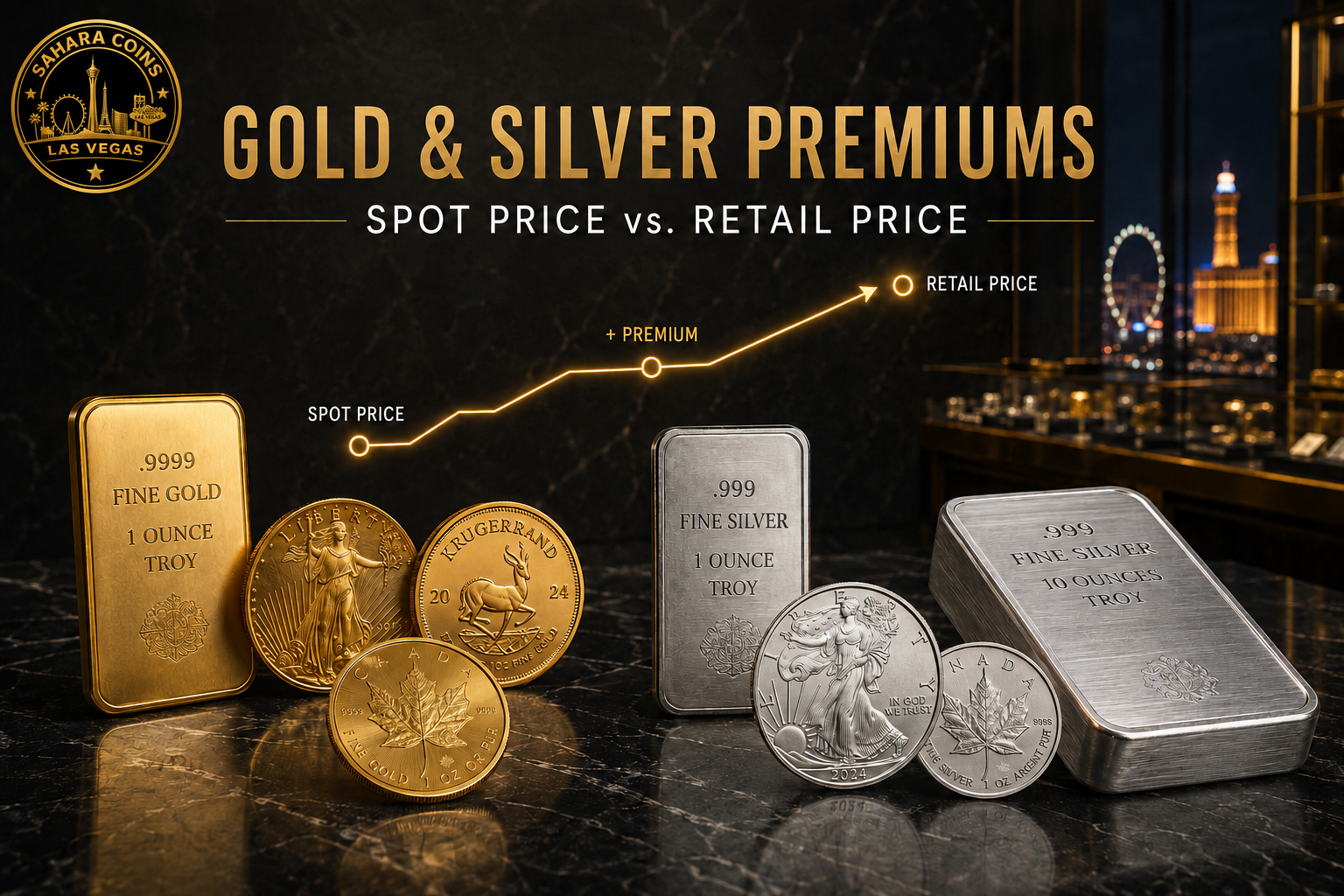
The spot price is a market reference price for immediate wholesale metal transactions. It is not necessarily the price a retail customer will pay for a physical coin or bar.
Physical products normally sell above spot because their price may include:
Refining
Minting
Fabrication
Transportation
Insurance
Wholesale distribution
Dealer overhead
Market demand
Product scarcity
This amount above the metal value is commonly called the premium.
When selling, a dealer’s offer may be at, above, or below spot depending on:
Product
Condition
Quantity
Authenticity
Current inventory
Wholesale demand
Market volatility
Resale costs
Investors should understand both the purchase premium and the likely resale spread before buying.
Precious Metals Do Not Produce Income
Unlike dividend-paying stocks, interest-bearing bonds, or rental property, physical precious metals do not produce cash flow.
An investor’s return generally depends on selling the metal for more than the combined cost of:
Purchase price
Premium
Shipping
Storage
Insurance
Financing
Selling expenses
This is one of the most important trade-offs to understand. Precious metals may provide diversification or wealth-preservation benefits, but they do not generate income simply by being held.
Storage and Security
Physical ownership requires a storage plan.
Common options include:
A properly secured home safe
A bank safe-deposit box
A private vault
Allocated professional storage
Insured depository storage
Each option involves trade-offs involving accessibility, privacy, insurance, cost, and security.
Investors should avoid discussing storage locations publicly. They should also keep accurate records and determine whether homeowners or renters insurance covers precious metals, since ordinary policy limits may be insufficient.
Counterfeits and Authentication
Counterfeit coins and bars exist. Investors should purchase from reputable sources and understand how products are verified.
Professional dealers may use:
Precision scales
Calipers
Magnets
Electrical-conductivity testing
Ultrasonic testing
X-ray fluorescence
Specific-gravity testing
Precious-metal verification equipment
Visual comparison with known genuine products
Packaging alone does not guarantee authenticity. Counterfeiters can imitate holders, labels, serial numbers, and certificates.
Avoid High-Pressure Sales Tactics
Investors should be cautious when a seller:
Guarantees profits
Claims precious metals cannot decline
Pressures the buyer to act immediately
Predicts a specific financial collapse
Promotes borrowing money to buy metals
Refuses to explain premiums and resale spreads
Pushes obscure products with enormous markups
Discourages comparison shopping
Will not provide written transaction details
FINRA advises precious-metal investors to avoid high-pressure salespeople, understand all fees, investigate the seller, and be particularly cautious with leverage. FINRA investor guidance
A reputable dealer should explain what a product is, how it is priced, and what factors could affect its resale value.
Taxes and Recordkeeping
Precious-metal transactions can create tax obligations.
The IRS generally treats gold, silver, gems, stamps, and coins as capital assets when they are held for investment rather than as dealer inventory. The tax treatment depends on factors such as holding period, basis, transaction type, and taxpayer circumstances. IRS Publication 544
IRS instructions also identify gold, silver, and platinum bullion as collectibles for certain long-term capital-gain calculations. IRS Schedule D instructions
Investors should retain:
Purchase receipts
Product descriptions
Dates
Quantities
Serial numbers when applicable
Shipping and insurance expenses
Storage costs
Sales records
Tax rules can change, and individual situations differ. Consult a qualified tax professional rather than relying on general online information.
How Much Should an Investor Own?
There is no universal allocation appropriate for everyone.
The answer depends on:
Financial goals
Income needs
Age
Time horizon
Existing assets
Emergency savings
Debt
Risk tolerance
Storage preferences
Reasons for buying
Expected holding period
Precious metals should be considered as part of an overall financial plan rather than as a reaction to fear, advertising, or short-term headlines.
Sahara Coins & Precious Metals does not provide individualized investment, legal, or tax advice. Customers should consult qualified professionals when making decisions involving retirement accounts, taxes, estate planning, or portfolio allocation.
Questions to Ask Before Buying
Before purchasing precious metals, ask:
Why am I buying?
How long do I intend to hold the metal?
Do I understand the difference between bullion and collectible coins?
What is the current spot price?
How much is the premium?
What would the product likely sell for today?
How recognizable is the product?
How will I verify authenticity?
Where will I store it?
Is it insured?
How much liquidity might I need?
Am I using borrowed money?
Have I compared products and dealers?
Do I understand potential tax consequences?
A clear answer to these questions can prevent expensive mistakes.
Buying Precious Metals in Las Vegas
Sahara Coins & Precious Metals has served Las Vegas and Southern Nevada for nearly 40 years. Our team offers more than 80 years of combined experience with bullion, rare coins, collectible currency, jewelry, and precious metals.
We buy and sell:
Gold bullion
Silver bullion
Platinum products
Palladium products
Government-issued bullion coins
Privately minted bars and rounds
Pre-1965 U.S. silver coins
Gold and silver jewelry
Rare and collectible coins
Precious-metal collections and estates
Our approach is centered on honesty, transparency, education, and professional service. We help customers understand the products they are considering, how premiums work, and the difference between bullion value and collectible value.
Visit Sahara Coins & Precious Metals at 7293 West Sahara Avenue, Suite 106, Las Vegas, Nevada 89117. Walk-ins are welcome.
Frequently Asked Questions
Are precious metals a safe investment?
Precious metals involve risk and can decline in value. They may provide diversification and other potential benefits, but they are not guaranteed to preserve principal or produce profits.
Is gold better than silver?
Neither metal is universally better. Gold stores more value in less space and generally has a deep global market. Silver has a lower entry price and substantial industrial demand but can be more volatile and requires more storage.
Do precious metals pay dividends or interest?
Physical metals do not generate dividends, interest, or cash flow. Returns depend primarily on changes in market value after accounting for premiums and other costs.
What is the difference between bullion and rare coins?
Bullion is valued mainly for metal content, while rare coins may carry additional value based on scarcity, condition, grade, history, and collector demand.
Why does physical metal cost more than spot?
Retail prices include fabrication, minting, transportation, insurance, distribution, dealer expenses, product availability, and market demand.
Can precious metals lose value?
Yes. Gold, silver, platinum, and palladium can all experience significant price declines.
Should I borrow money to buy precious metals?
Borrowing introduces interest expense, leverage, and the possibility of forced liquidation or additional losses. FINRA specifically warns investors about leverage risk in precious-metals transactions.
Where can I buy gold and silver in Las Vegas?
Sahara Coins & Precious Metals buys and sells gold, silver, platinum, palladium, bullion, rare coins, and other precious-metal products at 7293 West Sahara Avenue, Suite 106.
Final Thoughts
Investors buy precious metals for diversification, tangible ownership, global recognition, potential wealth preservation, industrial demand, and protection against certain financial risks.
Those potential advantages must be balanced against price volatility, premiums, storage, insurance, taxes, counterfeiting, and the fact that physical metals do not generate income.
The best approach is an informed one. Understand why you are buying, choose recognizable products, work with a reputable dealer, ask about premiums and resale spreads, maintain accurate records, and avoid making decisions based on pressure or fear.