How Much Is My Gold Worth? Spot Price, Melt Value, and Dealer Offers Explained
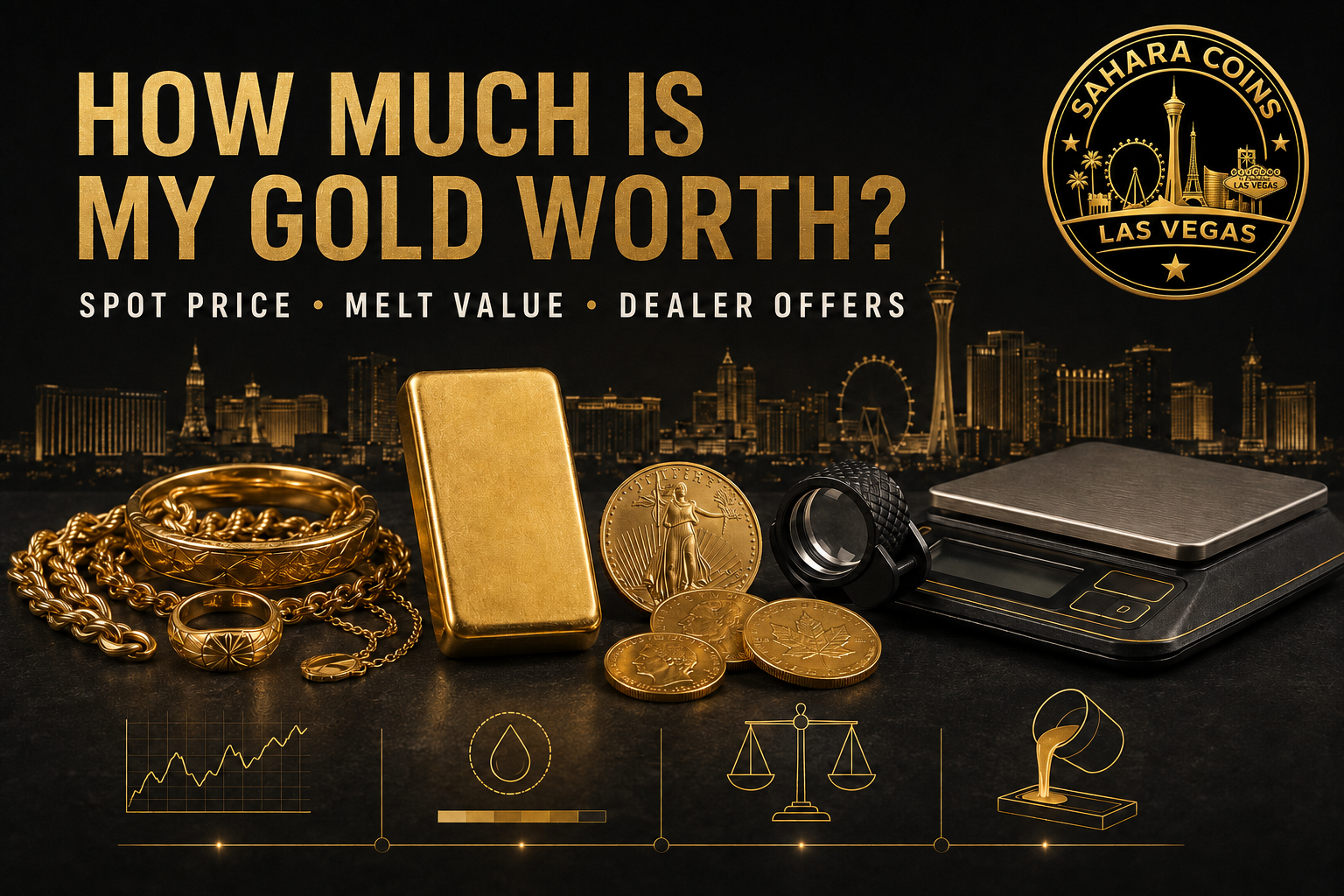
“How much is my gold worth?” sounds like a simple question, but the answer depends on more than the gold price shown online.
The value of a gold item can be affected by its purity, actual gold weight, current spot price, form, condition, market demand and whether it has collectible or designer value. A broken 14-karat chain, a one-ounce bullion coin and a rare pre-1933 U.S. gold coin may all contain gold, but they should not be evaluated in the same way.
At Sahara Coins & Precious Metals in Las Vegas, we believe customers should understand what they have and how it is valued before deciding whether to sell. This guide explains the difference between spot price, melt value and a dealer offer—and why identifying an item correctly matters.
The Quick Answer: What Determines the Value of Gold?
For most gold items, an evaluation begins with four questions:
What is the item? Jewelry, bullion, a collectible coin, dental gold or another form of gold can have different markets.
How much does it weigh? Precious metals must be weighed accurately, usually in grams or troy ounces.
What is its purity? A 14K item contains less pure gold than an 18K or 22K item of the same weight.
Is it worth more than its gold content? Rare coins, recognized bullion products, designer jewelry and certain vintage pieces may have additional value.
The current gold spot price provides a starting benchmark. It does not, by itself, tell you the final value of every item.
What Is the Gold Spot Price?
The gold spot price is the current market benchmark for one troy ounce of pure gold. One troy ounce is approximately 31.1035 grams.
Gold trades in global markets, so its spot price can move throughout the day. Economic reports, interest-rate expectations, currency movements, geopolitical events and investment demand can all influence the market.
If you would like a deeper explanation, read our guide to how gold prices are determined.
The important point for a seller is that spot price refers to pure gold in the wholesale market. Most jewelry is not pure gold, and many gold items include non-gold components that must be considered during an evaluation.
Step 1: Determine the Gold Purity
Gold jewelry is commonly alloyed with other metals to improve durability, change its color or make it suitable for everyday wear. Karat markings describe how much of the alloy is gold.
10K gold: 10 parts gold out of 24, or approximately 41.7% gold
14K gold: 14 parts gold out of 24, or approximately 58.3% gold
18K gold: 18 parts gold out of 24, or 75% gold
22K gold: 22 parts gold out of 24, or approximately 91.7% gold
24K gold: essentially pure gold, subject to the product's stated fineness
You may also see fineness marks such as 417, 585, 750, 916 or 999. These markings can be useful clues, but they are not conclusive proof. Stamps can be worn, incorrect or counterfeit, and some genuine older pieces may have no visible mark.
Before relying on a hallmark alone, a professional buyer should verify the metal. Our guide to solid gold, gold-filled and gold-plated jewelry explains several common markings and visual clues.
Step 2: Determine the Actual Gold Weight
Weight is the next part of the calculation, but the gross weight of an item is not always the same as its gold weight.
A ring may contain a gemstone. A watch may include a movement, crystal, steel spring bars or other non-gold parts. A necklace can have a non-gold clasp or added components. Dirt, adhesive and repair materials can also affect the scale.
That is why a professional evaluation considers both weight and construction. An accurate scale is essential, but the person conducting the evaluation must also identify which portions of the item are actually made of the stated gold alloy.
Step 3: Estimate the Theoretical Melt Value
Theoretical melt value is the value of the recoverable precious metal before refining, handling, market risk and other costs are considered.
A simplified calculation is:
Item weight in grams × gold purity ÷ 31.1035 × current gold spot price = estimated theoretical melt value
For example, consider a hypothetical 20-gram item that tests as 14K gold and contains no stones or non-gold components:
20 grams × 58.3% purity = approximately 11.66 grams of pure gold
11.66 grams ÷ 31.1035 = approximately 0.375 troy ounce of pure gold
0.375 × the current gold spot price = the item's approximate theoretical melt value
This calculation is educational, not a guaranteed offer. The actual evaluation can change if the item contains stones, filled sections, solder, non-gold parts, uncertain purity or value beyond its metal content.
Why Is a Dealer Offer Different From Melt Value?
Customers sometimes expect a jewelry item to be worth the full spot value of its gross weight. That comparison usually combines two different things: the wholesale benchmark for pure gold and a finished item that may contain an alloy, non-gold parts or costs associated with resale or refining.
A professional buyer may need to account for:
Verified purity and recoverable gold content
Stones and non-gold components
Refining, assay and processing costs
Market movement between purchase and resale or refining
The form and liquidity of the item
Quantity and current demand
Whether the item can be resold intact
Potential collectible, numismatic, vintage or designer value
A clear evaluation should explain what the item is, how its purity and weight were determined, and whether the offer is based mainly on precious-metal content or another market.
Gold Bullion Is Valued Differently From Scrap Jewelry
Recognized gold bullion coins and bars are generally easier to price than mixed or broken jewelry because their weight and fineness are standardized. Authenticity, condition, brand, product type and current dealer demand can still affect the price.
Popular bullion products may trade close to their metal value, above it or below it depending on current supply and demand. A product that carried a large retail premium when purchased does not necessarily retain that entire premium when sold.
Common bullion items include:
American Gold Eagles
American Gold Buffalos
Canadian Gold Maple Leafs
South African Krugerrands
Recognized one-ounce and fractional gold bars
Other government-issued gold bullion coins
If you are considering selling bullion or investment gold, visit our Sell Gold in Las Vegas page to learn about Sahara Coins' evaluation process.
Some Gold Coins Are Worth More Than Their Gold Content
A gold coin should not automatically be treated as scrap.
Pre-1933 U.S. gold coins, scarce dates, rare mintmarks and professionally certified coins may have numismatic value above their gold content. Condition, originality, rarity, grading, collector demand and certification by services such as PCGS or NGC can all affect the market value.
This is one reason experience in both precious metals and numismatics matters. Melting or selling a rare coin strictly by weight could overlook a substantial collector premium.
Sahara Coins evaluates both metal content and potential collectible value when customers sell gold coins in Las Vegas.
Designer, Estate and Vintage Jewelry May Have Additional Value
Not every piece of jewelry should be valued only for scrap.
Recognized designer names, desirable vintage styles, workmanship, gemstones and overall condition can sometimes create a resale market above the metal value. In other cases, a piece may be worth primarily for its precious-metal content.
An experienced evaluation should consider both possibilities before an offer is made. If you have inherited, vintage, broken or unwanted pieces, our Sell Jewelry in Las Vegas page explains the types of gold, silver and platinum jewelry we evaluate.
How Is Gold Tested?
Professional buyers may use more than one testing method depending on the item. These can include:
Visual inspection and hallmark review
Precision weighing
Electronic precious-metal analysis
Magnet and density testing
Traditional verification methods when appropriate
No single quick test is perfect for every item. Plating, unusual alloys, solder, hollow construction and counterfeit products can complicate an evaluation. A knowledgeable buyer selects the appropriate methods and interprets the results in the context of the entire item.
What Should You Expect From a Reputable Gold Evaluation?
Before accepting an offer, you should feel comfortable asking questions. A professional buyer should be willing to explain:
The tested or verified purity
The relevant weight
The current market benchmark being used
Whether stones or other components were excluded
Whether the item may have collectible or resale value
How the offer was determined
You should also know whether the evaluation is free, whether there is any obligation to sell and when payment is made.
At Sahara Coins, evaluations are free, walk-ins are welcome and there is no obligation to sell. If you accept an offer, payment is made immediately.
Frequently Asked Questions About Gold Value
Can I estimate my gold's value at home?
You can create a rough estimate if you know the item's accurate weight, verified purity and the current gold spot price. However, home estimates can be inaccurate when an item contains stones, non-gold components, plating, hollow sections or collectible value. A professional evaluation is the best way to determine what you actually have.
Is 14K gold worth 58.3% of the spot price?
Fourteen-karat gold is theoretically 58.3% pure, but that does not mean the entire gross weight of every 14K item is automatically worth 58.3% of the quoted price of a troy ounce. The item must be weighed, non-gold components considered and purity verified. Spot price is also a benchmark, not a guaranteed retail or purchase price.
Does broken gold jewelry still have value?
Yes. Broken chains, bent rings, single earrings and damaged jewelry can still contain valuable gold. Condition matters less when an item is valued primarily for its metal content, although condition can matter greatly for designer, vintage or collectible pieces.
Do diamonds and gemstones add value?
Sometimes. The value depends on the type, quality, size, condition and marketability of the stones. Small or heavily worn stones may contribute little, while significant diamonds or desirable gemstones may need a separate evaluation.
Should I clean my gold before bringing it in?
No special cleaning is necessary. Aggressive chemicals or polishing can damage finishes, gemstones and collectible surfaces. Bring the item in as it is, along with any original packaging, receipts, certificates or grading documents you already have.
Do I need an appointment to have gold evaluated?
No. Walk-ins are welcome at Sahara Coins during regular business hours.
Find Out What Your Gold Is Worth in Las Vegas
An online formula can provide a starting estimate, but an accurate offer requires correctly identifying the item, verifying its purity, measuring the relevant weight and recognizing any value beyond the gold content.
Sahara Coins & Precious Metals has served Las Vegas and Southern Nevada since 1997. We evaluate gold jewelry, bullion, coins, scrap gold, dental gold, nuggets and inherited collections at our West Sahara Avenue showroom near Summerlin.
Visit Sahara Coins to sell gold in Las Vegas, call (702) 367-4360, or stop by 7293 West Sahara Avenue, Suite 106, Las Vegas, Nevada 89117. Evaluations are free, walk-ins are welcome and there is no obligation to sell.