Gold and Silver Premiums Explained: How Much Over Spot Should You Pay?
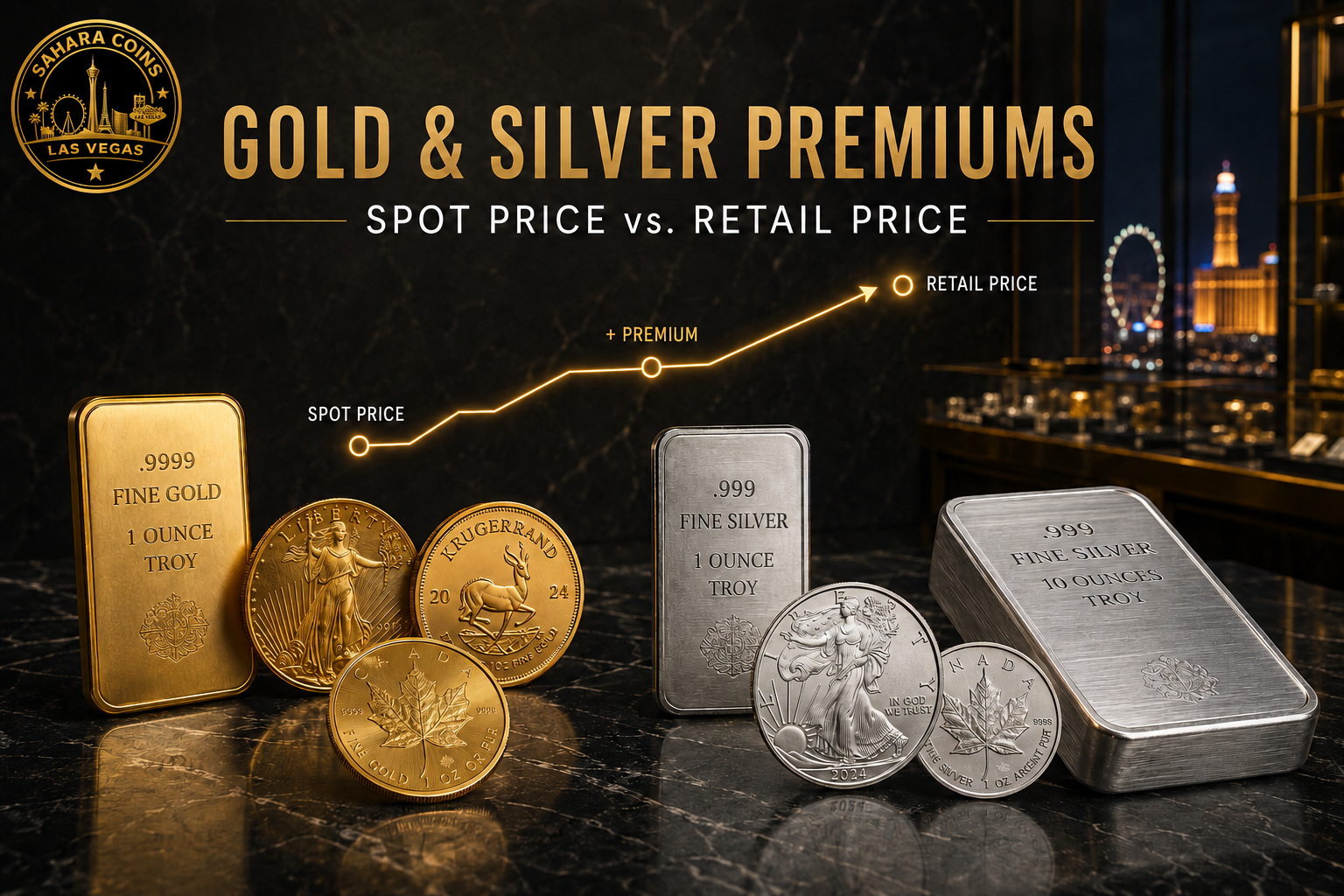
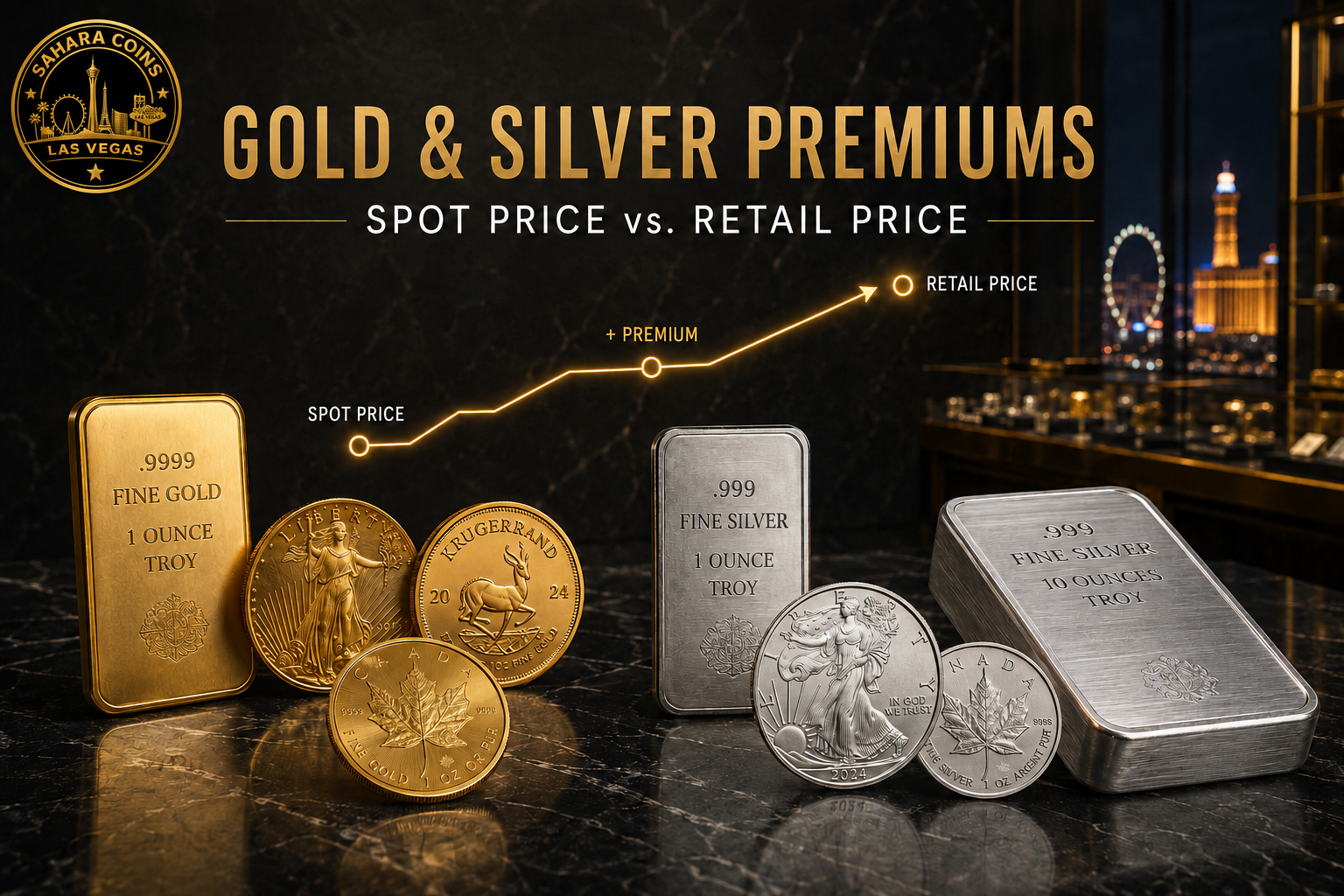
The price of physical gold or silver is almost always higher than the metal’s quoted spot price. The difference is called the premium over spot.
A fair premium is not one fixed percentage that applies to every bullion product. It depends on the metal, product size, mint or refiner, availability, market demand and the dealer’s replacement cost.
Before buying bullion, compare the complete price of the same product, understand what is included in the premium and consider how easily the item may be sold in the future.
If you are comparing physical precious metals locally, explore Sahara Coins’ current options for buying gold in Las Vegas and buying silver in Las Vegas.
What Is the Spot Price of Gold or Silver?
The spot price is a market benchmark representing the current value of precious metal for immediate settlement in wholesale markets.
Gold, silver, platinum and palladium spot prices change throughout the trading day as buyers and sellers react to factors such as:
Supply and demand
Interest-rate expectations
Inflation expectations
Currency movements
Central-bank activity
Industrial demand
Geopolitical events
Futures-market trading
Investor sentiment
The spot price is useful for measuring the underlying metal’s value, but it is not normally the price at which an individual can purchase a finished coin, round or bar.
Physical bullion must be refined, manufactured, transported, insured, stored and distributed before it reaches a retail customer. Those costs contribute to the premium.
What Does “Premium Over Spot” Mean?
The premium is the amount added to the underlying metal value when a physical bullion product is sold.
The basic calculation is:
Retail bullion price − metal value = premium
For example, imagine that the metal value of a one-ounce gold bar is $4,600 and its retail price is $4,750.
The premium would be:
$4,750 − $4,600 = $150
To express that premium as a percentage:
$150 ÷ $4,600 × 100 = approximately 3.26%
This is only an illustrative example. Spot prices and retail bullion prices change continuously.
Why Does Physical Bullion Cost More Than Spot?
Several expenses and market conditions affect the price of a finished bullion product.
Refining and Manufacturing
Gold and silver must be refined to the appropriate purity and turned into coins, rounds or bars.
Manufacturing may include:
Refining raw metal
Creating dies and molds
Minting or casting
Quality control
Weighing and testing
Serial numbering
Assay certification
Protective packaging
A government-minted coin with a detailed design may cost more to manufacture than a basic privately minted bar.
Wholesale Premiums
Retail dealers generally purchase bullion from mints, refiners, distributors, wholesalers or other market participants.
Those products may already carry a wholesale premium above spot before they reach the dealer. Wholesale premiums can rise when demand increases or supplies become limited.
Shipping, Insurance and Security
Precious metals require secure transportation and insurance. Dealers must also maintain appropriate security, storage and business insurance.
These costs are part of delivering genuine physical products safely to customers.
Market Supply and Demand
Physical bullion demand does not always move in perfect alignment with the spot market.
During periods of unusually strong demand, popular products may become difficult or expensive to replace. A dealer’s premium may rise even if the spot price remains relatively stable.
When retail demand decreases and inventory becomes plentiful, premiums may decline.
Dealer Operating Costs
A professional local dealer has expenses that an anonymous private seller may not have, including:
Trained employees
A secure physical location
Precious-metal testing equipment
Insurance and regulatory compliance
Inventory financing
Fraud prevention
Payment-processing expenses
Authentication and quality-control procedures
The lowest advertised price is not always the lowest complete cost or the safest transaction.
How Premiums Differ Among Bullion Products
Two products containing the same amount of metal can sell for different prices.
| Bullion Product | Typical Premium Tendency | Primary Reason |
|---|---|---|
| Larger generic bars | Often lower per ounce | Manufacturing costs are spread across more metal |
| One-ounce private-mint bars | Low to moderate | Efficient format with broad availability |
| Private-mint silver rounds | Low to moderate | No government face value and relatively efficient production |
| Government bullion coins | Moderate to higher | Government minting, recognition and product demand |
| Fractional gold | Higher per ounce | Similar production costs applied to less metal |
| Limited or specialty bullion | Variable | Design, mintage, popularity and collector demand |
| Rare or numismatic coins | Not directly comparable | Value may depend on rarity and condition, not just metal |
These are general tendencies rather than guaranteed rules. Current availability and demand can temporarily change the normal relationship between products.
Why Fractional Gold Usually Has a Higher Percentage Premium
Fractional gold products contain less than one full troy ounce.
Common sizes include:
1 gram
2.5 grams
5 grams
1/10 ounce
1/4 ounce
1/2 ounce
Smaller pieces require less money per purchase, but manufacturing, packaging and distribution costs do not decrease in direct proportion to their gold content. Consequently, fractional products generally carry a higher premium per ounce.
That does not automatically make fractional gold a poor choice. It may provide:
A lower initial purchase amount
Greater flexibility when selling
Multiple individual units
Convenient gift options
The ability to make smaller purchases over time
Buyers must balance affordability and divisibility against premium efficiency.
Why Government Bullion Coins May Cost More
Government-issued bullion coins frequently carry higher premiums than comparable generic bars or rounds.
Popular examples include:
American Gold Eagles
American Gold Buffalos
American Silver Eagles
Canadian Gold Maple Leafs
Canadian Silver Maple Leafs
Austrian Philharmonics
South African Krugerrands
These products may command additional premiums because of their issuing mint, recognizable designs, legal-tender status and established secondary-market demand.
A higher premium does not guarantee that the entire premium will be recovered when the product is sold. However, widely traded bullion coins may receive stronger buyback bids than less familiar products under certain market conditions.
The correct comparison is not simply which item is cheapest today. Buyers should also consider recognition, liquidity and the expected resale market.
What Is a Dealer Spread?
The dealer spread is related to the premium, but the terms do not mean exactly the same thing.
Retail price: What a customer pays to purchase the product
Buyback price: What a dealer would currently pay to purchase that product
Spread: The difference between those two prices
For example, a dealer may sell a bullion coin above spot while purchasing the same type of coin at spot, below spot or above spot, depending on current demand and replacement needs.
A narrow spread can be attractive, but spreads change. A product with a strong buyback today is not guaranteed to receive the same bid years from now.
Ask about the dealer’s general buyback process before purchasing, but treat any future price projection cautiously.
How Much Over Spot Should You Pay?
There is no honest universal answer such as “never pay more than a certain percentage.”
A reasonable premium is the competitive current price for the same product, quantity, payment method and delivery terms.
Before deciding whether a premium is fair, ask:
What is the current spot price?
How much precious metal does the product contain?
What is the total purchase price?
What is the dollar premium per piece?
What is the percentage premium over metal value?
Is the product widely recognized?
Is it currently difficult to obtain?
Are payment, shipping or insurance fees added later?
What is the dealer’s current buyback price for the same product?
Would a different product better fit my goals?
A one-ounce silver round should not be compared directly with a Silver Eagle solely by price. Likewise, a fractional Gold Eagle should not be compared with a one-ounce generic gold bar without accounting for size, recognition and divisibility.
How to Compare Bullion Quotes Correctly
When comparing prices from different dealers, make sure every part of the quote is equivalent.
Compare the Same Product
Compare the same:
Metal
Weight
Purity
Mint or manufacturer
Condition
Year or type, when relevant
Quantity
A generic secondary-market bar and a newly issued government coin are not identical products, even if they contain the same amount of metal.
Compare the Final Price
Online advertisements may exclude:
Shipping
Insurance
Credit-card surcharges
Minimum-order requirements
Membership fees
Delayed-payment conditions
Compare the complete amount required to receive the product—not merely the first price displayed.
Confirm the Payment Method
Cash, check, bank wire and credit-card transactions may carry different prices because payment-processing costs and settlement risks differ.
Ask which payment method applies to the quoted price.
Consider Immediate Availability
An online price for delayed shipping is not necessarily equivalent to purchasing an item that can be inspected and taken home immediately.
Some buyers prefer the convenience and privacy of online delivery. Others value speaking with a knowledgeable local dealer, examining the product and avoiding shipping risks.
Should You Always Buy the Lowest-Premium Bullion?
Not necessarily.
Lower-premium bullion may be appropriate if your priority is obtaining the greatest amount of metal for your budget. However, premium is only one consideration.
A buyer may reasonably pay more for:
A widely recognized government coin
Greater resale flexibility
Smaller divisible units
A trusted mint or refiner
Sealed assay packaging
A particular design or series
Immediate local availability
Be cautious about paying a large premium for a product based only on claims that it is “exclusive,” “rare” or guaranteed to outperform ordinary bullion.
Bullion and collectible coins serve different purposes. If an item carries a substantial collectible premium, its rarity, condition, mintage and established collector demand should be evaluated separately from its metal content.
Questions to Ask a Gold or Silver Dealer
A professional bullion dealer should be willing to explain pricing without pressure.
Before purchasing, consider asking:
What spot-price source is being used?
When was the quote calculated?
What is the premium in dollars and as a percentage?
Why does this product cost more than another option?
Are there additional payment or transaction fees?
Is the product new or secondary market?
Does the item come with original packaging or an assay card?
How is authenticity verified?
What happens if I eventually want to sell it?
Are lower-premium alternatives currently available?
The Commodity Futures Trading Commission also recommends that precious-metal buyers understand the complete price, fees and costs before completing a transaction.
Buying Bullion From a Local Las Vegas Dealer
Buying locally allows you to inspect available products, ask questions and compare several options in person.
At Sahara Coins & Precious Metals, our team can help you compare:
Gold bullion coins
Gold bars
Fractional gold
Silver Eagles
Silver rounds
Silver bars
90% United States silver coins
Platinum and palladium products
IRA-eligible precious metals
Inventory and premiums change with market conditions. Call ahead if you are looking for a particular product, weight or quantity.
Sahara Coins has served Las Vegas and Southern Nevada since 1997 from our physical showroom at 7293 West Sahara Avenue, Suite 106.
Frequently Asked Questions
Can I buy gold or silver at the exact spot price?
Finished retail bullion is normally sold above spot because refining, manufacturing, transportation, insurance, distribution and dealer costs must be covered. Certain secondary-market conditions can occasionally create unusual pricing, but spot should not be assumed to be the standard retail purchase price.
Are gold bars cheaper than gold coins?
Gold bars often carry lower premiums than government bullion coins, particularly in larger sizes. This is a general tendency, not a guarantee. Brand, size, availability and demand all affect the actual premium.
Why are Silver Eagles priced higher than generic silver rounds?
American Silver Eagles are government-issued bullion coins with strong recognition and collector demand. Generic rounds are produced by private mints and often have lower manufacturing and distribution costs.
Do I receive the premium back when I sell?
Not necessarily. Buyback prices depend on spot, product type, condition, inventory and current market demand. Some recognizable products may receive stronger bids, but no future premium is guaranteed.
Is a lower premium always better?
A lower premium can help maximize metal for your budget, but buyers should also consider product recognition, liquidity, divisibility, authenticity, condition and future resale flexibility.
Where can I compare gold and silver bullion in Las Vegas?
Sahara Coins & Precious Metals offers gold, silver and other precious-metal products from its Las Vegas showroom. Customers can compare available coins, rounds and bars and ask questions before purchasing.
Compare Gold and Silver Bullion in Las Vegas
Understanding premiums makes it easier to compare physical precious metals without focusing on spot price alone.
Before purchasing, compare identical products, calculate the complete premium, ask about additional costs and choose bullion that fits your budget, storage plan and need for future flexibility.
Visit Sahara Coins & Precious Metals at 7293 West Sahara Avenue, Suite 106, Las Vegas, Nevada 89117, or call (702) 367-4360 to ask about current gold and silver inventory.
Explore our current options for buying gold in Las Vegas or buying silver in Las Vegas.
This article is provided for general educational purposes and is not individualized investment, legal or tax advice. Precious-metal prices and premiums fluctuate, and buyers and sellers can experience losses.