90% U.S. Silver Coins (“Junk Silver”) Explained
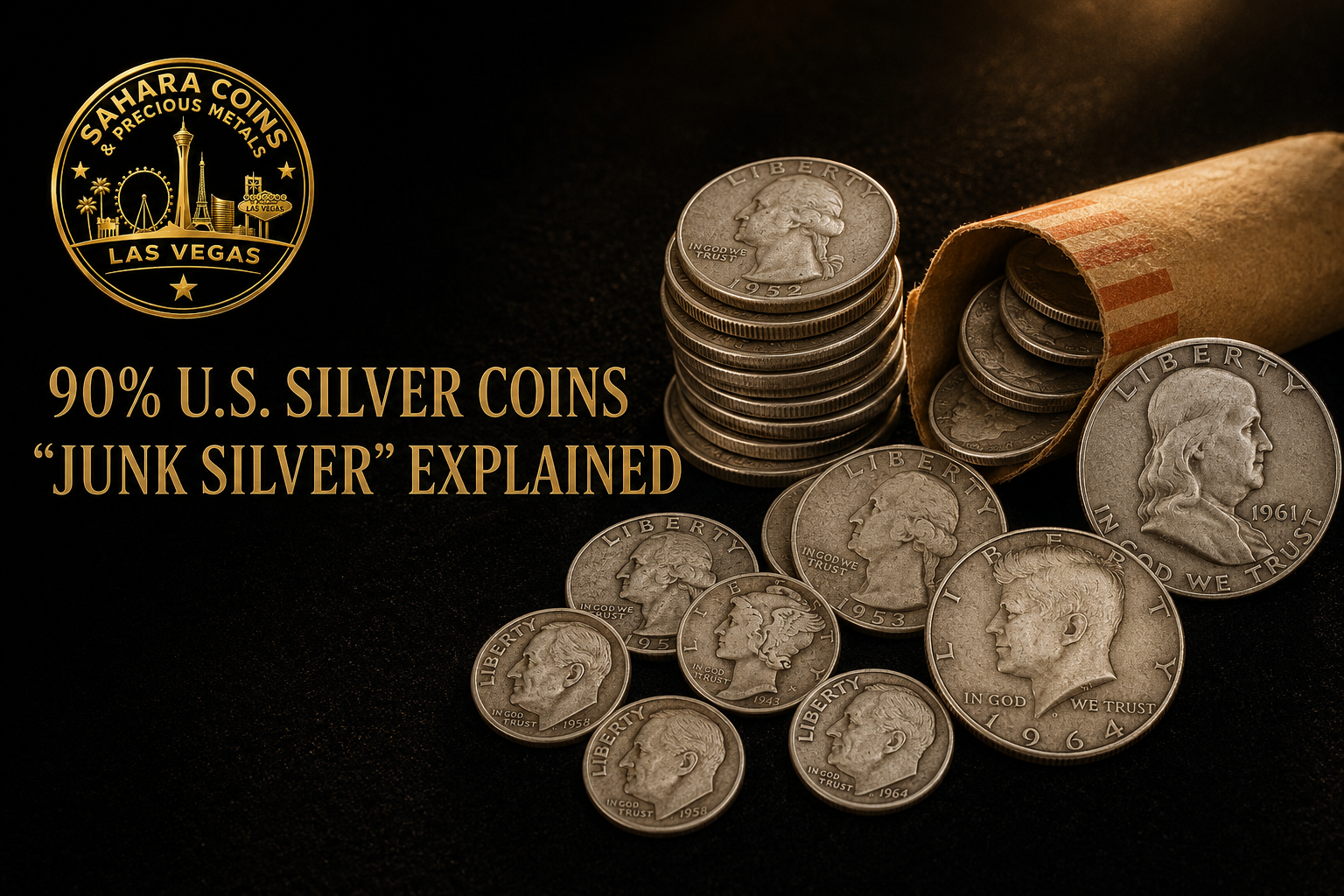
Before 1965, many everyday U.S. dimes, quarters, and half dollars were made from an alloy containing 90% silver and 10% copper. These coins once circulated as ordinary money, but today they are commonly bought and sold for their precious-metal content.
Within the bullion market, they are often called “junk silver.”
Despite the name, these coins are not junk. They are genuine United States coins with recognizable designs, established silver content, and legal-tender denominations. Many investors appreciate them because they combine fractional silver ownership with American history and broad market recognition.
However, not every old silver coin should be treated as bullion. Certain dates, mintmarks, varieties, and high-grade examples may be worth considerably more as collectibles
This guide explains what 90% silver is, which coins qualify, how much silver they contain, how they are priced, and what to examine before buying or selling them.
What Is “Junk Silver”?
“Junk silver” is an informal bullion-market term generally used to describe circulated U.S. silver coins that do not carry a substantial collectible premium.
The term commonly applies to:
Pre-1965 Roosevelt dimes
Mercury dimes
Pre-1965 Washington quarters
Circulated Standing Liberty quarters
1964 Kennedy half dollars
Franklin half dollars
Walking Liberty half dollars
Other common-date 90% silver coins
These coins are normally purchased in groups and priced according to their total face value rather than individually.
For example:
Ten dimes equal $1 in face value
Four quarters equal $1 in face value
Two half dollars equal $1 in face value
The word “junk” does not mean counterfeit, damaged, or worthless. It simply indicates that the coins are being traded primarily for their silver content rather than as individual numismatic rarities.
Why Were U.S. Coins Made From Silver?
For much of American history, precious metals formed an important part of the nation’s circulating coinage.
Silver was used in denominations ranging from the half dime to the silver dollar. By the 20th century, U.S. dimes, quarters, and half dollars were generally struck from an alloy containing:
90% silver
10% copper
The copper added strength and durability because pure silver is relatively soft.
These coins were used in ordinary commerce. Americans spent silver dimes, quarters, and half dollars at grocery stores, restaurants, gas stations, and countless other businesses.
A U.S. Mint technical report notes that through 1964, American dimes and higher denominations were traditionally struck in 90% silver. United States Mint
Why Did the United States Stop Using 90% Silver?
By the early 1960s, rising silver demand and changing market conditions made it increasingly difficult to continue producing circulating coins from the traditional 90% silver alloy.
The Coinage Act of 1965 removed silver from circulating dimes and quarters and authorized new copper-nickel clad compositions. The silver content of the half dollar was reduced rather than eliminated immediately. United States Mint
This created several important collecting and bullion dates:
Dimes dated 1964 and earlier generally contain 90% silver.
Quarters dated 1964 and earlier generally contain 90% silver.
Kennedy half dollars dated 1964 contain 90% silver.
Kennedy half dollars dated 1965 through 1970 contain 40% silver.
Regular circulating dimes and quarters dated 1965 and later generally contain no silver.
There are special collector issues and rare transitional errors that do not follow these basic rules, but the date guidelines work for most coins encountered by the public.
Which U.S. Coins Contain 90% Silver?
Several familiar U.S. coin series fall into the 90% silver category.
Roosevelt Dimes
Regular Roosevelt dimes dated.
1946–1964
contain 90% silver.
Roosevelt dimes dated 1965 and later are generally copper-nickel clad unless they are special collector issues
Mercury Dimes
Mercury dimes were issued from:
1916–1945
The coin’s official name is the Winged Liberty Head dime, although the figure’s winged cap led the public to associate the design with Mercury.
Common-date circulated Mercury dimes are frequently included in 90% silver bullion holdings. Key dates and better-condition examples may carry substantial collectible premiums.
Barber DimeS
Barber dimes were issued from:
1892–1916
Many heavily circulated common dates trade near their silver value, but older coins should always be examined for scarce dates, mint marks, and varieties before being included in a bullion lot.
Washington Quarters
Regular Washington quarters dated:
1932–1964
contain 90% silver
Washington quarters dated 1965 and later are generally copper-nickel clad, except for certain collector products.
Standing Liberty Quarters
Standing Liberty quarters were issued from:
1916–1930
Heavily circulated common dates may trade as 90% silver, but several dates and varieties have significant numismatic value
The date is positioned in an area that wore quickly on early examples, so some Standing Liberty quarters have no readable date. Dateless examples are commonly treated as bullion.
Barber Quarters
Barber quarters were issued from:
1892–1916
Common, heavily circulated examples may be traded for their silver content, but many dates deserve individual evaluation.
1964 Kennedy Half Dollars
Kennedy half dollars dated:
1964
contain 90% silver.
They were issued shortly after President John F. Kennedy’s assassination and remain popular with both bullion investors and collectors.
Franklin Half Dollars
Franklin half dollars were issued from:
1948–1963
Every regular-issue Franklin half dollar contains 90% silver. Most common circulated examples trade as bullion, while high-grade pieces and certain varieties may be collectible.
Walking Liberty Half Dollars
Walking Liberty half dollars were issued from:
1916–1947
Common circulated examples are often included in 90% silver lots. Key dates, scarce mintmarks, and higher-grade coins should be evaluated separately.
Barber Half Dollars
Barber half dollars were issued from:
1892–1915
Heavily worn common examples may trade near their silver value, but these older coins should be checked carefully before being sold as bullion
How Much Silver Is in 90% U.S. Coinage?
When originally minted, $1 in face value of 90% silver dimes, quarters, or half dollars contained approximately:
0.7234 troy ounce of pure silver
This can be made up in several ways:
Coin CombinationFace ValueOriginal Silver Content10 silver dimes$1.00Approximately 0.7234 troy oz.4 silver quarters$1.00Approximately 0.7234 troy oz.2 silver half dollars$1.00Approximately 0.7234 troy oz.
Because circulated coins lose a small amount of metal through wear, dealers and investors frequently use approximately:
0.715 troy ounce per $1 face value
as a practical estimate for average circulated 90% silver.
Actual silver content can vary slightly depending on the type of coins and the amount of wear.
Common Face-Value Estimates
Using the circulated estimate of 0.715 troy ounce per dollar:
Face ValueApproximate Silver Content$10.715 troy oz.$53.575 troy oz.$107.15 troy oz.$5035.75 troy oz.$10071.5 troy oz.
These figures are estimates rather than guarantees for every group of circulated coins.
Why Is 90% Silver Sold by Face Value?
Unlike one-ounce rounds or bars, each individual silver dime, quarter, or half dollar contains only a fraction of a troy ounce.
Calculating the silver value of every coin separately would be inconvenient. The bullion market therefore commonly quotes 90% silver by the total face value of the coins.
A dealer might quote 90% silver as:
A dollar amount per $1 face value
A multiple of face value
A price per $10 face-value roll
A price based on the current silver spot price plus a premium
For example, if a dealer quotes 90% silver at “22 times face value,” a $10 face-value roll would cost:
$10 × 22 = $220
That is only an illustration. Actual market pricing changes continually based on silver prices, product availability, investor demand, and dealer spreads.
How Is the Melt Value Calculated?
A basic estimate for circulated 90% silver can be calculated using this formula:
Face value × 0.715 × current silver spot price
For example, if someone has $10 in face value:
$10 × 0.715 = 7.15 troy ounces of estimated silver
The estimated metal value would then be:
7.15 × current silver spot price
The actual retail purchase price or dealer buyback price will normally differ from the calculated melt value.
Reasons include:
Dealer premiums
Wholesale market conditions
Local supply and demand
Coin type
Coin condition
Order size
Refining and handling costs
Current market volatility
Spot price is a useful reference point, but it is not automatically the price at which physical silver can be purchased or sold.
Why Do Investors Buy 90% Silver Coins?
Recognizable U.S. Coinage
These coins were produced by the United States Mint and carry familiar denominations and designs.
Their recognizable appearance can make them easier to identify than unfamiliar privately minted products.
Fractional Silver Content
Each dime, quarter, or half dollar contains less than one ounce of silver.
This gives owners the ability to sell small portions of a holding rather than liquidating a large bar.
Historically Significant
These coins circulated through American commerce and represent a period when everyday money contained precious metal.
Durable and Convenient
U.S. silver coins were designed for circulation. Normal scratches and wear generally do not prevent common-date coins from trading as bullion.
Broad Investor and Collector Demand
The market for pre-1965 U.S. silver remains well established among coin dealers, collectors, and precious-metals investors.
No Need for Assay Packaging
Unlike many small gold bars, 90% silver coins are not normally sealed in assay cards. They can be organized in tubes, rolls, bags, or other protective containers.
Potential Disadvantages of 90% Silver
Although 90% silver offers several advantages, it may not be appropriate for every buyer.
Premiums Can Change
During periods of strong demand, pre-1965 silver coins may carry significant premiums above their melt value.
Silver Content Is Not Printed on the Coin
Unlike a modern one-ounce round, these coins do not state their silver weight or purity.
Wear Affects Actual Weight
Older, heavily circulated coins may contain slightly less silver than they did when originally minted.
Sorting May Be Required
Mixed bags can contain collectible dates, extremely worn coins, damaged pieces, or coins with different silver compositions.
Storage Requires Space
Like other forms of physical silver, large quantities of 90% coinage can become heavy and require secure storage.
“Junk Silver” vs. Silver Rounds and Bars
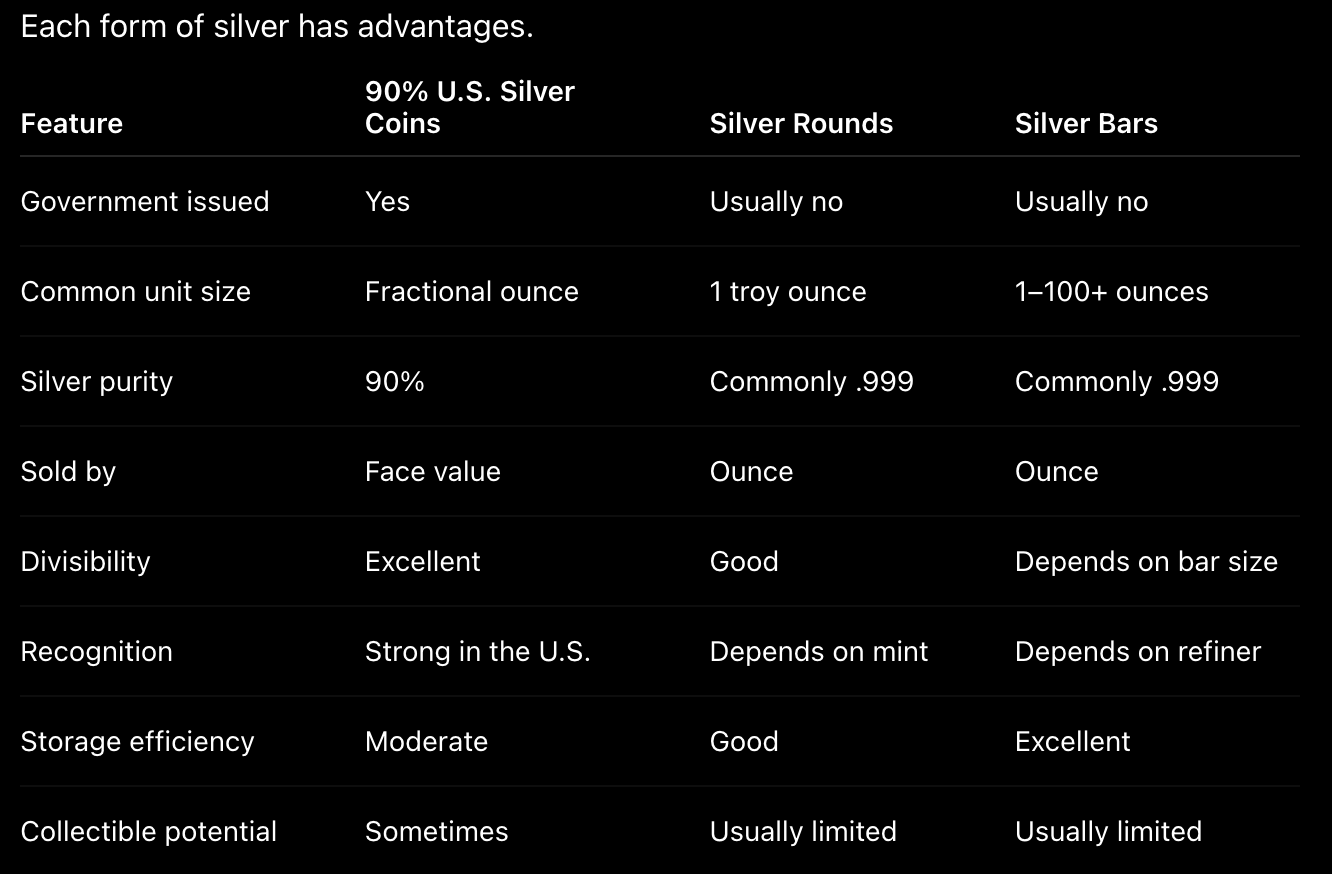
Investors do not necessarily need to choose only one format. Some build a core position in lower-premium bars while holding 90% silver for divisibility and historical appeal.
Are Silver Dollars Considered Junk Silver?
Morgan and Peace Dollars are made from an alloy containing 90% silver and 10% copper, but they are usually treated differently from dimes, quarters, and half dollars.
A Morgan or Peace Dollar contains approximately:
0.7734 troy ounce of silver when originally minted
That is more silver than the amount represented by $1 face value in dimes, quarters, or halves.
Silver dollars also frequently carry stronger collectible premiums due to:
Their large size
Historical popularity
Date and mintmark collecting
Scarce varieties
Condition
Strong numismatic demand
Common circulated silver dollars may be sold in bulk, but they should not be calculated using the standard 0.715-ounce-per-dollar estimate applied to circulated dimes, quarters, and halves.
Are 1965–1970 Kennedy Half Dollars 90% Silver?
No, Kennedy half dollars dated 1965 through 1970 generally contain:
40% silver
Only the regular 1964 Kennedy half dollar contains 90% silver
The 40% silver half dollars have different weights and silver content, so they should be separated from 90% coinage when calculating value.
Certain later Kennedy half dollars were also produced in silver compositions for special collector sets, but they require individual identification.
Are Wartime Nickels Considered 90% Silver?
No. Certain Jefferson nickels produced from 1942 through 1945 contain:
35% silver
These coins are often called wartime silver nickels or war nickels.
They can usually be identified by the large mintmark above Monticello on the reverse. Although they contain silver, they should not be mixed into calculations for 90% coinage.
How to Identify a Silver Dime or Quarter
The easiest first step is checking the date.
Dimes
Regular U.S. dimes dated 1964 and earlier generally contain 90% silver.
Quarters
Regular U.S. quarters dated 1964 and earlier generally contain 90% silver.
Another clue is the coin’s edge.
Modern clad dimes and quarters usually display a visible copper-colored stripe along the edge. A 90% silver coin generally has a more consistently silver-colored edge.
However, appearance alone is not always conclusive. Plated, altered, counterfeit, and special collector coins exist. Professional testing may be appropriate for unusual pieces or large quantities.
Can 90% Silver Coins Have Collectible Value?
Yes. Before treating old silver coins as bullion, check for:
Key dates
Low mintages
Scarce mintmarks
Doubled dies
Overdates
Repunched mintmarks
Better varieties
High-grade examples
Proof coins
Attractive original toning
Unusually sharp details
An extremely worn common-date Washington quarter may be valued primarily for silver. A scarce-date quarter in collectible condition could be worth many times its metal value.
This is especially important with older designs such as:
Barber coinage
Mercury dimes
Standing Liberty quarters
Walking Liberty half dollars
If you are unfamiliar with a collection, have the coins evaluated before selling them strictly by weight or face value.
Should You Clean Old Silver Coins?
No. Cleaning silver coins can permanently alter their surfaces and reduce potential collector value.
Avoid:
Silver polish
Abrasive cloths
Baking soda
Chemical dips
Wire brushes
Household cleaners
Scrubbing
Mechanical polishing
Natural toning, dirt, and signs of age do not automatically make a coin less valuable
Even if most of a group ultimately trades as bullion, cleaning the coins provides little benefit and may damage collectible pieces hidden in the lot.
How Should 90% Silver Be Stored?
Common storage options include:
Coin tubes
Paper rolls
Archival-quality flips
Plastic coin boxes
Canvas or heavy-duty coin bags
Secure home safes
Safe-deposit boxes
Insured private storage
Keep silver in a dry, stable environment.
For larger holdings, maintain a private inventory that records:
Total face value
Coin denominations
Approximate silver content
Purchase dates
Purchase prices
Photographs
Storage location
Avoid PVC-containing holders because they can damage coin surfaces over time.
Buying 90% Silver Coins
Before purchasing, ask:
Is the price quoted per dollar of face value?
Which denominations are included?
Are the coins readable and identifiable?
Are any coins bent, holed, clipped, or excessively worn?
Does the group include 40% silver halves?
Have collectible dates been removed?
What premium is being charged?
What is the dealer’s current buyback method?
Are the coins sold as a mixed lot or by denomination?
Some investors prefer dimes because they provide the greatest number of individual pieces per dollar of face value. Others prefer half dollars because they are easier to count and handle.
The best choice depends on your goals and the premiums available at the time.
Selling 90% Silver Coins
When selling, keep different silver compositions separated.
Create separate groups for
90% silver dimes
90% silver quarters
90% silver half dollars
40% silver Kennedy half dollars
35% silver wartime nickels
Morgan and Peace Dollars
Foreign silver coins
Potentially collectible coins
A reputable coin dealer should identify the coins, confirm the silver composition, calculate the total face value, and explain how the offer is determined.
If the coins came from an inherited collection, request an evaluation before assuming everything should be sold as bullion.
90% Silver Coins at Sahara Coins & Precious Metals
At Sahara Coins & Precious Metals, we help customers throughout Las Vegas and Southern Nevada buy, sell, and understand pre-1965 U.S. silver coinage.
Whether you have a few silver dimes, a roll of Washington quarters, a bag of inherited coins, or a larger accumulation of U.S. silver, our knowledgeable team can help identify:
Silver composition
Total face value
Approximate precious-metal content
Better dates and mintmarks
Collectible coins
Current bullion value
Available buying or selling options
We also carry a changing selection of 90% silver coins, silver rounds, government bullion coins, and silver bars for customers building physical precious-metals holdings.
Ready to sell 90% silver coins in Las Vegas? Visit our Sell Silver in Las Vegas page for bullion-value coins, or explore Sell Coins and Collections in Las Vegas when an inherited group may contain collectible dates, mint marks or varieties. Ready to Sell Silver Coins? Learn More
This article is provided for general educational purposes and is not individualized investment, legal, or tax advice. Silver prices fluctuate, premiums change, and precious metals can decline in value.
Frequently Asked Questions
What Does “Junk Silver” Mean?
“Junk silver” is a bullion-market nickname for common circulated U.S. silver coins valued primarily for their precious-metal content. The term does not mean the coins are worthless or fake.
What Years of U.S. Coins Contain 90% Silver?
Regular U.S. dimes and quarters dated 1964 or earlier generally contain 90% silver. Kennedy half dollars dated 1964 contain 90% silver. Earlier half-dollar designs also generally contain 90% silver.
How Much Silver Is in $1 Face Value?
When originally minted, $1 face value in 90% silver dimes, quarters, or half dollars contained approximately 0.7234 troy ounce of pure silver. For average circulated coins, the market often uses approximately 0.715 troy ounce to account for wear.
How Many Silver Dimes Equal One Ounce of Silver
A newly minted 90% silver dime contains approximately 0.07234 troy ounce of silver. Therefore, about 13.8 unworn dimes equal one troy ounce of pure silver. In practice, circulated wear may slightly affect the amount.
How Much Silver Is in a Roll of Dimes?
A standard roll of 50 dimes has a face value of $5. Using the common circulated estimate, it contains approximately 3.575 troy ounces of silver.
How Much Silver Is in a Roll of Quarters?
A standard roll of 40 quarters has a face value of $10. Using the circulated estimate, it contains approximately 7.15 troy ounces of silver.
How Much Silver Is in a Roll of Half Dollars?
A standard roll of 20 half dollars has a face value of $10. If all are 90% silver, the roll contains approximately 7.15 troy ounces of silver using the circulated estimate.
Are All 1964 Coins Silver?
No. Dimes, quarters, and half dollars from 1964 generally contain 90% silver, but cents and nickels do not. The silver composition depends on the denomination.
Are 1965 Quarters Silver?
Regular 1965 quarters are copper-nickel clad and do not contain silver. Rare transitional errors may exist, but ordinary 1965 quarters are not silver coins.
Is Junk Silver a Good Investment?
Some investors value 90% silver for its recognizability, divisibility, and historical appeal. However, prices and premiums fluctuate, and physical silver involves storage, security, spreads, and market risk.
Where Can I Sell 90% Silver Coins in Las Vegas?
Sahara Coins & Precious Metals evaluates and purchases U.S. silver coins at its Las Vegas showroom. The team can separate bullion-value coins from pieces that may deserve individual numismatic evaluation.
Looking to purchase 90% United States silver or compare it with modern bullion? Visit our Buy Silver in Las Vegas page to learn about available coins, rounds and bars.