The Educational Notes of 1896: History, Designs, Value, and Collecting Guide
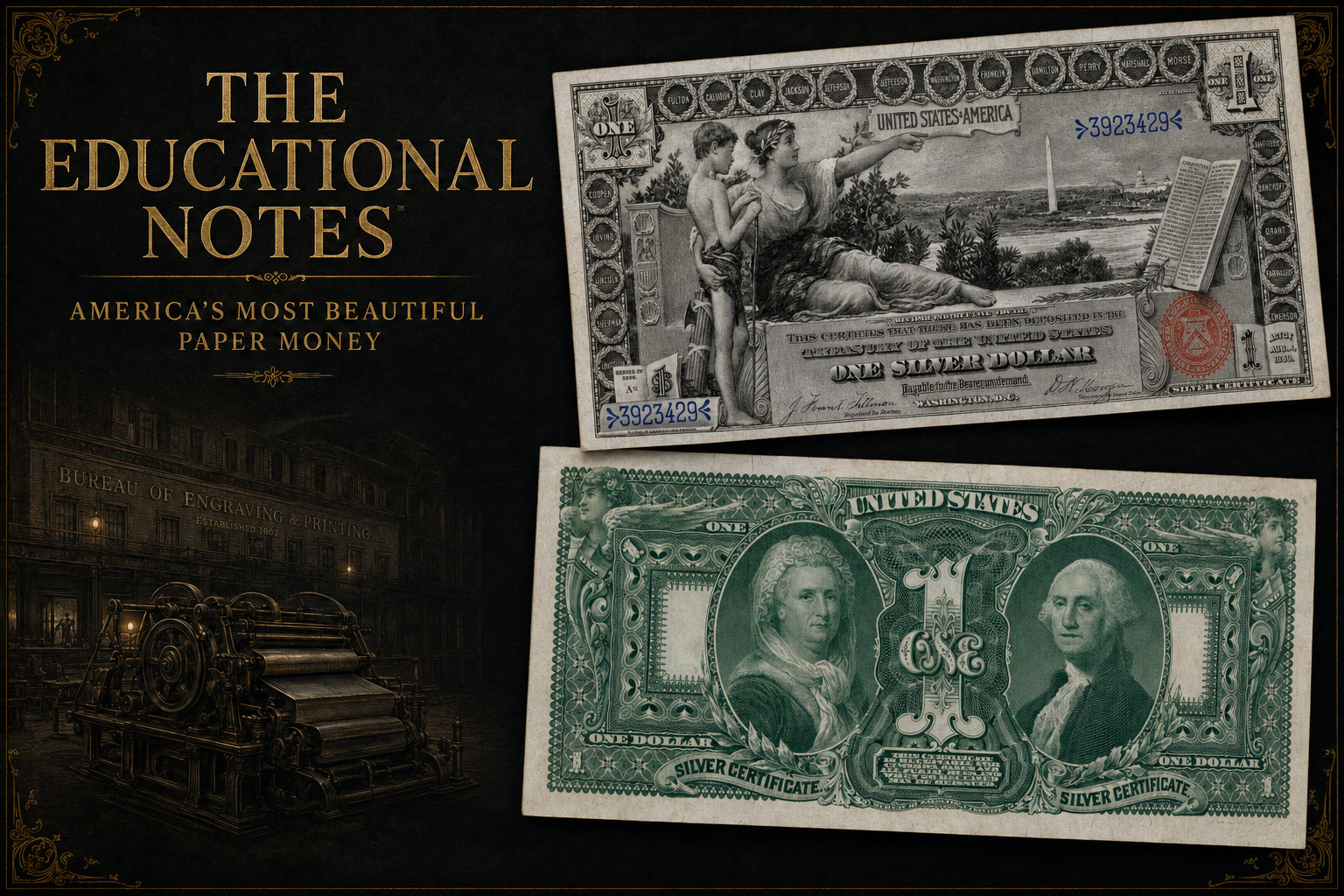
The Educational Series of 1896 is often described as the most beautiful paper money ever issued by the United States. Created during an era when American public art celebrated history, science, industry, and national progress, these extraordinary silver certificates look more like miniature murals than ordinary currency.
Only three denominations were issued: the $1, $2, and $5 Silver Certificates. Each features an elaborate allegorical scene on its face and portraits of notable Americans on its back. Together, they form one of the most recognizable and desirable sets in United States paper-money collecting.
Although collectors commonly call them “Educational Notes,” the name did not appear as an official Treasury title. It grew from the artwork on the $1 note, History Instructing Youth, and eventually came to describe the entire 1896 series.
Whether you inherited an old large-size note, are considering purchasing your first Educational Silver Certificate, or want to understand why this three-note series is so important, this guide covers its history, designs, artists, varieties, grading, value factors, preservation, and enduring appeal.
What Are Educational Notes?
Educational Notes are United States Silver Certificates from the Series of 1896. The federal government issued them in three denominations:
Denomination=$1 Face Design: History Instructing Youth. Back Portraits: Martha and George Washington
Denomination=$2 Face Design: Science Presenting Steam and Electricity to Commerce and Manufacture Back Portraits:Robert Fulton & Samuel F. B. Morse
Denomination=$5 Face Design: Electricity as the Dominant Force in the World Back Portraits: Ulysses S. Grant and Philip H. Sheridan
These are “large-size” notes, meaning they are physically larger than the standardized small-size currency introduced in 1929. Their broad surfaces gave artists and engravers room to create unusually detailed, mural-like compositions.
The series was short-lived. Notes began entering circulation in 1896, but the complex designs were soon replaced by the more practical Series of 1899 Silver Certificates. That brief production period, combined with their artistry and age, has made the Educational Notes enduring classics.
What Was a Silver Certificate?
Silver Certificates were a form of United States paper currency backed by silver held by the Treasury. They were first authorized in the late 19th century as part of legislation involving the government’s purchase and coinage of silver.
The obligation printed on the face of an 1896 Educational Note stated that silver dollars had been deposited in the Treasury and were payable to the bearer on demand. In practical terms, the certificate represented a claim on silver dollars held by the federal government.
The notes circulated alongside other forms of American money, including United States Notes, National Bank Notes, Treasury Notes, and later Federal Reserve Notes.
Silver Certificates are no longer redeemable for silver. The final opportunity to redeem them for silver bullion ended on June 24, 1968. They remain valid United States currency at face value, but an authentic Educational Note is normally worth far more to collectors than its printed denomination.
Why Did the Government Create Such Elaborate Currency?
During the 1890s, Bureau of Engraving and Printing Chief Claude M. Johnson pursued a dramatically different approach to American currency design. Rather than relying entirely on conventional portraits, numerals, geometric engraving, and ornamental borders, the Bureau commissioned established muralists to create broad allegorical scenes.
The idea reflected the artistic culture of the period. Monumental public artwork was appearing in government buildings, expositions, libraries, and state capitols. Allegorical figures representing History, Science, Electricity, Commerce, Manufacture, Fame, and Peace were familiar visual language to Americans of the era.
In 1893, the Bureau commissioned artists Will H. Low, Edwin Howland Blashfield, and Walter Shirlaw. All three were experienced painters and muralists. Their large compositions were translated into steel engravings by some of the Bureau’s most talented engravers.
The result was a series unlike anything the United States had placed into everyday circulation before—or since.
The $1 Educational Silver Certificate
The $1 Educational Note is the most accessible denomination in the series and the source of the series’ popular name.
Face: History Instructing Youth
The face was designed by artist Will H. Low. Its title, History Instructing Youth, appears at the bottom of the scene.
The central allegorical figure of History sits beside a young boy representing Youth. History directs the child’s attention toward an open book displaying the United States Constitution. The composition suggests that the nation’s future depends on teaching each generation about its founding principles and civic heritage.
In the distance are two of Washington, D.C.’s most recognizable landmarks:
The United States Capitol
The Washington Monument
The surrounding border contains wreaths bearing the names of notable Americans associated with the nation’s political, military, scientific, literary, and cultural development.
Will H. Low’s design was approved in 1894. Charles Schlecht engraved the principal face vignette, while Bureau Chief Engraver Thomas F. Morris revised portions of the borders and lettering.
The “Tranquility” Spelling Story
The Constitution reproduced on the note inspired an unusual controversy. Observers noticed that “tranquility” appeared with one “l” and claimed the note contained a spelling error.
However, the spelling followed the wording used in the original Constitution. Both one- and two-“l” spellings have historical usage, so the note was not the error some people believed it to be.
The story remains a favorite piece of Educational Note history and illustrates how closely the public examined the new designs.
Back: Martha and George Washington
The back features Martha Washington on the left and George Washington on the right, separated by a large central numeral “1.”
Martha Washington holds a unique place in American currency history. She is the only real, named woman to have received a prominent portrait on regular-issue United States paper currency. She appeared alone on earlier $1 Silver Certificates and beside her husband on the 1896 Educational Note.
The arrangement reportedly drew criticism from people who disliked seeing the large numeral placed between George and Martha Washington. Today, the paired portraits are considered one of the note’s most memorable features.
Friedberg Numbers
The two principal catalog varieties are:
Fr. 224
Fr. 225
The difference is based primarily on the Treasury signature combination. Collectors use Friedberg numbers as the standard shorthand for identifying federal paper-money varieties.
The $2 Educational Silver Certificate
The $2 note is widely admired for its ambitious depiction of scientific discovery and industrial advancement.
Face: Science Presenting Steam and Electricity to Commerce and Manufacture
The face was designed by Edwin Howland Blashfield. Its complete title is Science Presenting Steam and Electricity to Commerce and Manufacture.
Science appears as the principal female figure near the top of the composition. She presents two youths representing the transformative forces of the age:
Electricity, associated with a galvanic coil
Steam, associated with a mechanical throttle
Below them are female figures representing Commerce and Manufacture. Commerce is associated with trade and finance, while Manufacture is surrounded by machinery and goods.
The scene celebrates the relationship between knowledge, invention, industrial production, and economic growth. It captures the optimism of an America being transformed by electrical power, steam transportation, telecommunications, factories, and national commerce.
Blashfield originally conceived this composition for a much higher denomination. Bureau officials adapted it for the $2 note after rejecting a different proposal. Thomas F. Morris designed the surrounding frame and background, while Charles Schlecht and G. F. C. Smillie helped translate the artwork into engraved form.
Back: Robert Fulton and Samuel F. B. Morse
The back honors two American innovators:
Robert Fulton, associated with the development of commercially successful steam navigation
Samuel F. B. Morse, co-developer of the Morse telegraph system and Morse code
The portraits reinforce the face design’s themes. Fulton represents the practical use of steam power, while Morse represents electrical communication.
Thomas F. Morris designed the back, and Lorenzo James Hatch engraved the portraits.
Friedberg Numbers
The principal $2 varieties are:
Fr. 247
Fr. 248
As with the $1 notes, the catalog distinction primarily reflects Treasury signatures.
The $5 Educational Silver Certificate
The $5 note is generally considered the most visually dramatic and challenging denomination in the series. It is also typically the most difficult of the three to acquire, especially in higher grades.
Face: Electricity as the Dominant Force in the World
Walter Shirlaw designed the panoramic face, titled Electricity as the Dominant Force in the World.
At the center is a winged female figure representing Electricity. She holds an electric light bulb, one of the most important technological symbols of the late 19th century.
Around her are additional allegorical figures and symbols:
Jupiter approaches with a lightning bolt, connecting ancient mythology with modern electrical power.
Fame sounds a trumpet over a map of the United States.
An American eagle stands watch.
Washington, D.C., appears in the distance.
Peace is represented with a dove.
The scene presents electricity as a force capable of advancing civilization, strengthening the country, and reshaping daily life. At the time, electric lighting and power systems were still novel and astonishing technologies. The note effectively turned a piece of circulating currency into a celebration of the modern age.
G. F. C. Smillie engraved the main face design. Thomas F. Morris also influenced the borders and ornamental elements.
Back: Ulysses S. Grant and Philip H. Sheridan
The back features two prominent Union generals from the Civil War:
Ulysses S. Grant on the left
Philip H. Sheridan on the right
Lorenzo James Hatch engraved the portraits. Morris, Smillie, and Hatch all contributed to the overall reverse design and execution.
Friedberg Numbers
The three principal catalog varieties are:
Fr. 268
Fr. 269
Fr. 270
These varieties represent different Treasury signature combinations. Because the $5 denomination is the scarcest of the issued Educational Notes, each variety receives significant collector attention.
The Artists and Engravers Behind the Series
Educational Notes were collaborative works. Muralists created the allegorical compositions, while Bureau employees adapted the artwork to the technical requirements of engraved currency.
Will H. Low
Low designed the $1 History Instructing Youth scene. He was known as an illustrator, muralist, and decorative painter.
Edwin Howland Blashfield
Blashfield created the $2 Science Presenting Steam and Electricity to Commerce and Manufacture. He became one of America’s most prominent muralists and produced important works for public buildings and expositions.
Walter Shirlaw
Shirlaw designed the $5 Electricity as the Dominant Force in the World. His composition is among the most ambitious allegorical scenes ever adapted to U.S. currency.
Thomas F. Morris
Morris, Chief of the Bureau’s Engraving Division, played a major role in translating the paintings into workable banknote layouts. He designed or revised borders, lettering, frames, backgrounds, and backs throughout the series.
Charles Schlecht
Schlecht engraved the main vignette on the $1 note and contributed to the engraving of the $2 design.
G. F. C. Smillie
Smillie contributed to the $2 and served as the principal engraver of the $5 face. He belonged to one of the best-known families in American banknote engraving.
Lorenzo James Hatch
Hatch engraved the portrait pairs on the $2 and $5 notes: Fulton and Morse, followed by Grant and Sheridan.
Numerous additional Bureau engravers worked on lettering, numerals, borders, seals, portraits, and ornamental details. The final notes were products of both individual artistry and institutional craftsmanship.
Why Were Educational Notes Discontinued?
The Educational Series achieved artistic greatness but encountered practical problems as circulating money.
Denominations Were Difficult to Identify Quickly
Bank tellers and merchants complained that the denomination numerals were not positioned prominently enough for rapid counting and sorting.
The Designs Could Become Hard to Read
The broad engraved scenes lacked some of the geometric lathework commonly used on currency faces. After heavy circulation, wear and smudging could make the intricate imagery appear muddy.
Counterfeiting Concerns
Some Bureau officials believed traditional geometric patterns offered stronger protection against counterfeiting. The pictorial faces departed from standard security-oriented design practices.
Objections to the Allegorical Figures
Certain members of the public objected to the partially nude classical figures, particularly the central representation of Electricity on the $5 note.
A Change in Treasury Leadership
Lyman J. Gage became Secretary of the Treasury in 1897 and favored currency that was more standardized, direct, and practical. The artistic experiment ended, and the Series of 1899 introduced more conventional designs.
The Educational Notes therefore remained a brief, remarkable chapter in American currency—a moment when monumental public art was placed into the hands of everyday citizens.
Planned Denominations That Were Never Issued
The $1, $2, and $5 notes were intended to be the beginning of a broader artistic series. Additional denominations were contemplated, including higher-value notes.
Design work was proposed or initiated for denominations such as $10, $20, $50, $100, $500, and $1,000. The $10 and $50 concepts progressed further than some of the others, but none of the higher denominations reached circulation.
Changes in policy and leadership ended the project before the full vision could be completed. Essays, proofs, sketches, or design studies associated with unissued denominations can be important specialized collectibles, but they are not regular-issue Educational Notes.
How Educational Notes Are Cataloged
Collectors commonly identify federal currency with Friedberg numbers, abbreviated “Fr.” These numbers distinguish denomination, series, design, signatures, seals, and other important varieties.
The issued Educational Note references are generally organized as follows:
DenominationCommon Friedberg References$1Fr. 224–225$2Fr. 247–248$5Fr. 268–270
Signature combinations include officials serving as Register of the Treasury and Treasurer of the United States. A different signature pairing can create a separate catalog number even when the artwork remains essentially the same.
For a collector, correctly identifying the Friedberg number is an important part of determining scarcity and market value.
What Determines the Value of an Educational Note?
Every genuine Educational Note has collector value, but the amount can vary dramatically. The main factors include denomination, catalog variety, condition, originality, appearance, and market demand.
Denomination
The $1 is generally the most available entry point. The $2 is scarcer, while the $5 is typically the most difficult and expensive denomination.
Friedberg Variety
Signature combinations were not printed in equal quantities and do not survive in equal numbers. A scarcer Friedberg number may command a premium over a more available variety.
Grade
Paper money grading considers:
Folds and circulation wear
Paper quality
Centering and margins
Color and ink strength
Tears or edge splits
Pinholes
Stains or discoloration
Missing paper
Repairs and restoration
Small differences in grade can produce substantial differences in value.
Original Paper Quality
Collectors prize notes that retain their original paper body, texture, embossing, and natural appearance. Notes that have been washed, pressed, chemically treated, or otherwise altered may be worth less than naturally preserved examples.
Eye Appeal
Two notes with the same numerical grade can look very different. Strong margins, balanced centering, vivid ink, clean paper, and an attractive overall appearance can make one example more desirable.
Problems and Repairs
Damage can significantly affect value. Common problems include:
Tears
Tape or adhesive residue
Rust stains
Ink writing
Mounting remnants
Trimmed edges
Repaired splits
Added or reconstructed paper
Pressing or washing
A restored note may still be collectible, especially when the underlying issue is scarce, but repairs should be disclosed and considered when comparing prices.
Professional Certification
Reputable third-party grading services authenticate, grade, and encapsulate collectible currency. Certification can be especially helpful for expensive Educational Notes because it gives buyers greater confidence regarding authenticity, condition, and disclosed problems.
Understanding Paper-Money Grades
Professional currency grading generally uses a numerical scale from 1 through 70.
Good to Very Good
Notes show heavy circulation, numerous folds, soiling, and possibly minor damage. The primary design remains identifiable.
Fine
The note has circulated substantially but retains solid overall design detail. Multiple folds and moderate wear are expected.
Very Fine
The note shows honest circulation with several folds but remains attractive and relatively crisp.
Extremely Fine
Only light circulation is evident. The note may have a few folds while retaining strong paper quality and visual appeal.
About Uncirculated
The note appears nearly new but has a light fold, handling mark, or other minor evidence that prevents an uncirculated grade.
Choice or Gem Uncirculated
The note has no circulation folds. Higher grades require increasingly strong centering, margins, originality, paper quality, and overall presentation.
Some grading services also use designations such as EPQ or PPQ to recognize exceptional or premium original paper quality.
Counterfeit, Altered, and Reproduction Educational Notes
Because Educational Notes are valuable and visually famous, collectors should be cautious about counterfeits, altered notes, and modern reproductions.
Potential warning signs include:
Flat printing without genuine engraved texture
Blurry or simplified linework
Incorrect paper
Artificial aging
Wrong colors
Missing security fibers
Inaccurate seals, serial numbers, or signatures
Identical serial numbers appearing on multiple supposed originals
“Replica,” “copy,” or facsimile markings hidden in the design
Some reproductions are sold honestly as decorative pieces. Problems arise when replicas are altered or represented as genuine.
Photographs alone may not be sufficient to authenticate a valuable note. A hands-on evaluation or certification from a respected grading service is advisable for expensive examples.
Should You Clean, Flatten, or Repair an Educational Note?
No home conservation should be attempted.
Do not:
Iron the note
Press it beneath heavy objects
Wash or soak it
Use an eraser
Apply tape
Glue tears
Trim uneven edges
Try to remove stains
These actions can permanently alter the paper and reduce collector value. Even a well-intentioned repair may be obvious to an experienced currency professional.
If a note requires conservation, consult a qualified paper conservator or a specialist familiar with collectible currency.
How to Store Educational Notes Safely
Nineteenth-century paper is vulnerable to moisture, light, heat, handling, and improper plastics.
For safe storage:
Use archival-quality, currency-sized holders.
Avoid holders containing PVC or unknown plasticizers.
Keep the note flat and fully supported.
Store it in a stable, cool, dry environment.
Limit exposure to direct sunlight and ultraviolet light.
Handle the holder rather than the note.
Keep food, drinks, adhesives, and ink pens away.
Certified notes should remain in their protective grading holders unless there is a compelling professional reason to remove them.
Ways to Collect the Educational Series
Collectors can approach the series at several levels.
A Single Type Note
Choose one representative Educational Note. The $1 is generally the most obtainable and includes the design that gave the series its name.
A Three-Denomination Set
Build a complete basic set containing one $1, one $2, and one $5 note.
A Friedberg Variety Set
Collect each principal signature variety:
Two $1 varieties
Two $2 varieties
Three $5 varieties
A Matched-Grade Set
Find all three denominations with comparable grades and visual quality. This can create a particularly attractive display.
A Certified Set
Build a set graded by a single third-party service, potentially with consistent holder generation or paper-quality designations.
An Advanced Art and Production Collection
Specialists may pursue proofs, specimens, essays, uncut material, archival impressions, engraver-related items, or designs associated with unissued denominations.
Why Educational Notes Remain So Popular
The Educational Series combines nearly every quality collectors value in historic paper money:
Extraordinary artwork
A brief production period
Large-size format
Important American historical themes
Famous artists and engravers
Portraits of inventors, presidents, military leaders, and Martha Washington
Multiple collecting levels
Strong crossover appeal among art, history, technology, and currency collectors
The notes also capture a distinctive moment in the country’s identity. The $1 looks toward history and civic education. The $2 celebrates science, steam, electricity, commerce, and manufacturing. The $5 presents electricity as a force reshaping the world.
Together, the three notes tell a story about where America believed it had been, what it had become, and where it hoped to go.
Have Your Educational Notes Evaluated at Sahara Coins
If you inherited an Educational Note, discovered large-size currency in a family collection, or are considering adding an 1896 Silver Certificate to your collection, professional evaluation can help you understand exactly what you have.
At Sahara Coins & Precious Metals in Las Vegas, we evaluate collectible United States currency based on authenticity, denomination, Friedberg number, signatures, condition, originality, repairs, and current collector demand.
Visit our Las Vegas showroom for a no-obligation evaluation of Educational Notes, Silver Certificates, large-size currency, National Bank Notes, obsolete currency, and complete inherited collections. Whether you are buying, selling, or simply researching a family heirloom, our knowledgeable team is committed to providing honest information and professional guidance.
Frequently Asked Questions
Why are they called Educational Notes?
The nickname comes from the $1 note’s allegorical face design, History Instructing Youth. Collectors eventually applied the term “Educational Series” to all three 1896 Silver Certificate denominations.
How many Educational Notes were issued?
Three denominations were issued: $1, $2, and $5. Higher denominations were contemplated, but none reached regular circulation.
Are Educational Notes real United States currency?
Yes. They are genuine United States Silver Certificates issued for circulation. They remain valid at face value, although authentic examples normally have much greater collectible value.
Can an Educational Note still be redeemed for silver?
No. Redemption of Silver Certificates for silver ended in 1968. They may only be redeemed at their face value as United States currency, which would not make financial sense for a collectible Educational Note.
Which Educational Note is the rarest?
The $5 is generally the scarcest of the three issued denominations and is usually the most challenging to acquire. Rarity also varies by Friedberg number and grade.
Who appears on the $1 Educational Note?
The back features Martha Washington and George Washington. The face presents the allegorical figures of History and Youth.
Who appears on the $2 Educational Note?
The back features inventors Robert Fulton and Samuel F. B. Morse. The face depicts Science presenting Steam and Electricity to Commerce and Manufacture.
Who appears on the $5 Educational Note?
The back features Ulysses S. Grant and Philip H. Sheridan. The face presents Electricity as the dominant force in the world.
Does the word “tranquility” make the $1 note an error?
No. The one-“l” spelling reproduced from the Constitution was accepted historical usage. It is an interesting feature, but it does not create a separate error-note variety.
Should I have my Educational Note professionally graded?
Certification may be worthwhile because authentication, grade, originality, and repairs significantly affect value. A currency professional can help determine whether the note is a good candidate for submission.
Where can I sell an Educational Note in Las Vegas?
Sahara Coins & Precious Metals evaluates Educational Notes and other collectible U.S. currency at its Las Vegas showroom. The team can explain the note’s denomination, catalog variety, condition, authenticity, and market factors before you decide whether to sell.