The Morgan Dollar: History, Key Dates, Value, and Collecting Guide
Few American coins are as recognizable—or as closely connected to the history of the American West—as the Morgan Silver Dollar. With its large size, classic portrait of Liberty, substantial silver content, and ties to famous mints such as Carson City, the Morgan Dollar has become one of the most widely collected coins in the United States.
First struck in 1878, the Morgan Dollar was born from a period of political debate, western silver discoveries, industrial growth, and national expansion. Millions were stored in government vaults for decades, millions more were melted, and many surviving examples eventually became treasured collectibles.
Whether you inherited a group of old silver dollars, are building your first collection, or simply want to understand why Morgan Dollars are so popular, this guide explains their history, design, mint marks, key dates, silver content, value factors, and lasting appeal.
What Is a Morgan Dollar?
The Morgan Dollar is a United States silver dollar designed by George T. Morgan. The original series was produced from 1878 through 1904 and then for one final year in 1921.
Original Morgan Dollars have a face value of one dollar and were made from:
90% silver
10% copper
26.73 grams total weight
38.1 millimeters in diameter
Approximately 0.7734 troy ounce of pure silver
The coin takes its familiar name from its designer rather than from a president, historical event, or place.
The Political and Economic Story Behind the Morgan Dollar
The history of the Morgan Dollar begins with a national argument over silver.
The Coinage Act of 1873 ended production of the standard silver dollar. Critics later called this change the “Crime of 1873,” especially after major silver discoveries increased the nation’s supply of the metal and drove silver prices lower. Western mining interests and many farmers and debtors supported the return of silver coinage, while others favored a monetary system centered more heavily on gold.
Congress responded with the Bland-Allison Act of 1878. The law restored the standard silver dollar and directed the U.S. Treasury to purchase large quantities of silver for coinage.
A new silver dollar design was needed, and the result became the Morgan Dollar.
The coin therefore was not created merely as a work of art. It grew directly from the mining economy, monetary policy, and political tensions of the late 19th century. Its history is inseparable from the Comstock Lode, the growth of the American West, and the country’s transformation into an industrial power.
Who Was George T. Morgan?
George T. Morgan was an English-born engraver who joined the United States Mint in 1876 as an assistant engraver. He later became Chief Engraver of the U.S. Mint, serving in that position from 1917 until his death in 1925.
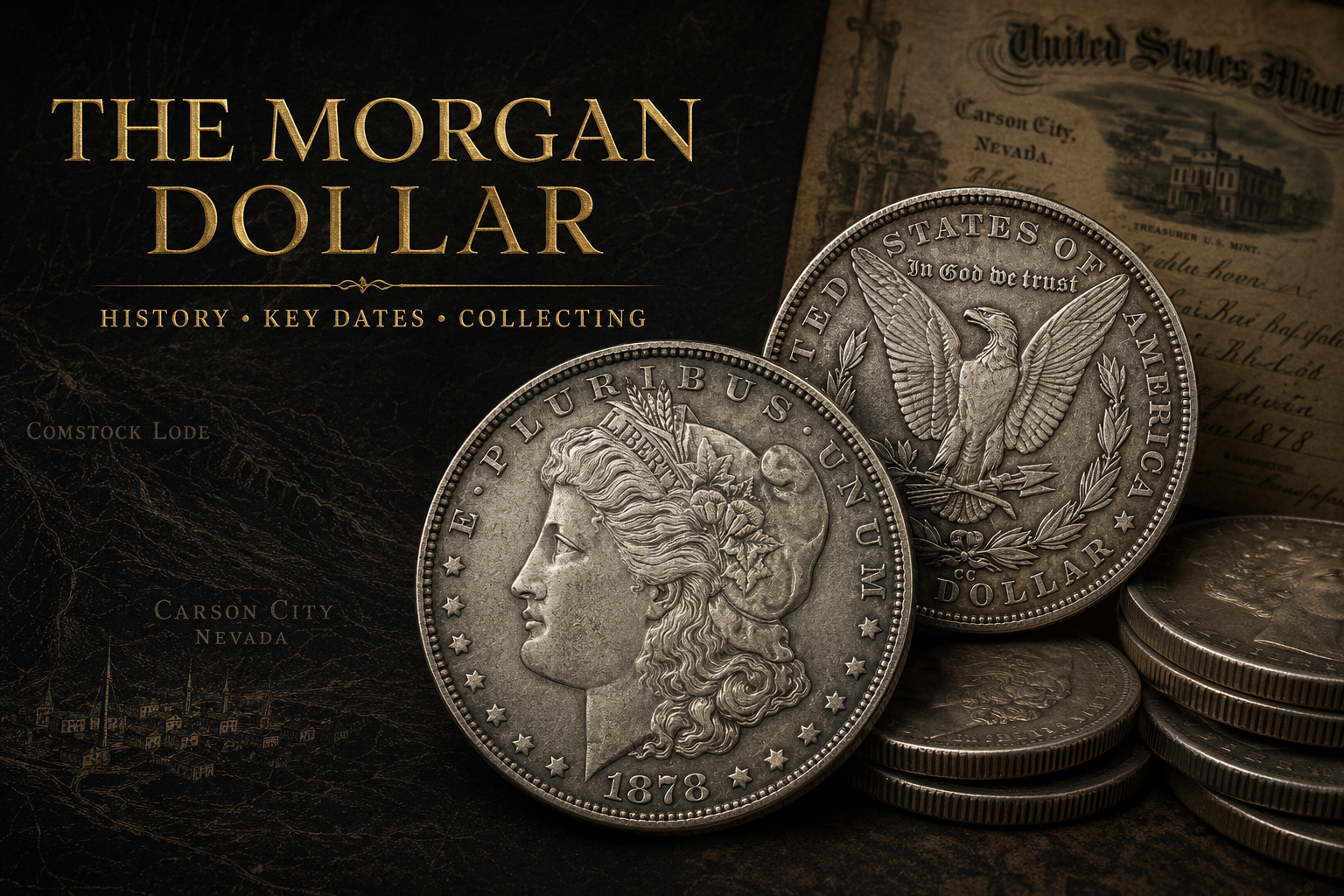
Morgan wanted his Liberty portrait to look distinctly American rather than imitate traditional European interpretations. His design presented Liberty in profile wearing a Phrygian cap, an agricultural wreath, and a headband inscribed with the word “LIBERTY.”
His silver dollar design became so closely associated with him that collectors soon began calling the coin the Morgan Dollar.
Understanding the Morgan Dollar Design
The artwork on the Morgan Dollar combines traditional American symbols with details that reflect the nation’s identity during the late 1800s.
Obverse: Lady Liberty
The front of the coin features a left-facing portrait of Liberty. Her cap is decorated with agricultural elements, including wheat and cotton, representing important parts of the American economy.
The obverse also includes:
“E PLURIBUS UNUM”
Thirteen stars representing the original colonies
The year of issue
The word “LIBERTY” on Liberty’s headband
Reverse: The American Eagle
The back of the coin features a bald eagle with its wings spread. The eagle holds arrows and an olive branch, traditional symbols of military readiness and peace.
The reverse also displays:
“UNITED STATES OF AMERICA”
“IN GOD WE TRUST”
“ONE DOLLAR”
A wreath of oak leaves and acorns
The mint mark, when present
The combination of Liberty, agricultural imagery, and a powerful eagle made the Morgan Dollar a fitting symbol of an expanding nation.
Where Were Morgan Dollars Minted?
Original Morgan Dollars were struck at five U.S. Mint facilities. The mint mark appears on the reverse, beneath the center of the wreath and above the letters “D” and “O” in “DOLLAR.”
MintMint MarkMorgan Dollar ProductionPhiladelphiaNo mint mark1878–1904 and 1921Carson CityCC1878–1885 and 1889–1893New OrleansO1879–1904San FranciscoS1878–1904 and 1921DenverD1921 only
The 1921-D Morgan Dollar was the only Morgan Dollar struck at the Denver Mint.
For Nevada collectors, Carson City Morgan Dollars carry special significance. The Carson City Mint was built near the source of the Comstock Lode’s enormous silver output, and its “CC” mint mark has become one of the most desirable marks in American numismatics.
The First Morgan Dollars of 1878
The first Morgan Dollars were struck at the Philadelphia Mint in March 1878. Production soon expanded to San Francisco and Carson City.
The first year is especially interesting because the Mint revised the eagle’s tail feathers and other design details. The earliest 1878 Philadelphia coins show an eagle with eight tail feathers. Later versions display seven tail feathers, and some dies show seven tail feathers over remnants of the earlier eight-tail-feather design.
Collectors commonly encounter descriptions such as:
1878 8 Tail Feathers
1878 7/8 Tail Feathers
1878 7 Tail Feathers
1878 Reverse of 1878
1878 Reverse of 1879
These variations make 1878 a fascinating area of specialization within the broader Morgan Dollar series.
Why Were So Many Morgan Dollars Stored?
Although the government produced enormous quantities of Morgan Dollars, the coins did not circulate evenly across the country. Paper money was more convenient, and a large silver dollar was heavy to carry. Demand was stronger in parts of the West, but many Americans rarely used silver dollars in daily commerce.
As a result, millions of Morgan Dollars were placed into canvas bags and stored in Treasury and bank vaults. Some remained untouched for decades.
This unusual history helps explain why certain Morgan Dollars with relatively large original mintages can still be found in uncirculated condition. It also explains how large groups of coins later entered the collector market at once.
The End of the Original Production Run
Morgan Dollar production continued through 1904. By then, the available silver purchased under earlier legislation had been largely exhausted, and demand for additional silver dollars was limited. Production stopped after 1904.
No U.S. silver dollars were struck from 1905 through 1920.
It appeared that the Morgan Dollar series had ended—but events surrounding World War I brought it back.
The Pittman Act and the Great Silver Dollar Melt
The Pittman Act of 1918 authorized the federal government to melt hundreds of millions of silver dollars and sell the resulting silver. Much of that silver supported wartime financial needs, including the stabilization of silver supplies abroad.
Government records show that 270,232,000 silver dollars were melted. Most were Morgan Dollars.
The law also required the government to purchase domestic silver and replace the melted dollars. To fulfill that obligation, the U.S. Mint resumed Morgan Dollar production in 1921.
The 1921 coins were struck at Philadelphia, San Francisco, and—uniquely for this series—Denver. Because new hubs and dies had to be created, the 1921 Morgan has a somewhat different, shallower-relief appearance than many earlier issues.
Later in 1921, the new Peace Dollar replaced the Morgan Dollar, bringing the original Morgan series to a close.
Treasury Releases and the GSA Carson City Dollars
One of the most remarkable chapters in Morgan Dollar history occurred long after the coins were made.
During the 20th century, the Treasury gradually released bags of silver dollars into circulation and the collector market. Interest accelerated in the early 1960s, when people discovered that sealed Treasury bags could contain scarce dates and mint marks.
After the Treasury stopped redeeming silver certificates for silver dollars, the government still held approximately 2.8 million uncirculated Carson City Morgan Dollars. The General Services Administration sold many of these coins to the public during a series of sales beginning in the 1970s.
Many were placed in distinctive black plastic holders with government packaging. Today, an original GSA holder can add historical interest and collector appeal, especially when the coin remains with its box and certificate.
These releases transformed the Morgan Dollar market. Dates once considered rare became more available, while the popularity of Carson City coins grew dramatically.
Important Morgan Dollar Key Dates
Not every Morgan Dollar is rare. Some dates were produced in very large quantities and remain accessible to beginning collectors. Others are scarce in nearly every grade or become major rarities in high-grade condition.
Among the most important issues are:
1893-S
With a circulation-strike mintage of only 100,000, the 1893-S is the lowest-mintage regular-issue Morgan Dollar and is widely considered the key business strike of the series. It is valuable even in heavily circulated condition and is frequently counterfeited or altered.
1889-CC
Only 350,000 were struck. The 1889-CC is one of the most desirable Carson City Morgan Dollars, and relatively few were represented in the major Treasury releases that made some other “CC” dates more available.
1895 Philadelphia Proof
Although Mint records report 1895 circulation strikes, no business-strike examples are confirmed today. The date is known to collectors through its Proof issue and is often called the “King of the Morgan Dollars.”
1893-CC
This was the final year of Morgan Dollar production at Carson City. Its low mintage, historic mint mark, and status as the last “CC” dollar make it especially popular.
1903-O
The 1903-O was once considered a major rarity. Treasury bag releases brought many uncirculated pieces to market, making it a classic example of how surviving population can matter more than original mintage alone.
Condition Rarities
Coins such as the 1884-S, 1892-S, 1895-O, 1896-O, and 1901 can be obtainable in circulated grades but extremely difficult and expensive in high Mint State grades.
This is why collectors should never judge rarity by mintage alone.
Morgan Dollar Varieties and VAMs
Morgan Dollars were struck from many individual die pairs, and those dies often developed identifiable differences. Collectors study doubled dates, repunched mint marks, over-mint marks, die breaks, polishing lines, and other characteristics.
These die varieties are commonly called VAMs, named for researchers Leroy C. Van Allen and A. George Mallis.
Some VAM varieties command meaningful premiums, while others appeal mainly to specialists. A dramatic variety, strong collector demand, and clear attribution usually matter more than the simple fact that a die difference exists.
Prooflike and Deep Mirror Prooflike Morgan Dollars
Some circulation-strike Morgan Dollars were made from freshly polished dies that produced highly reflective fields. Grading services may designate qualifying coins as:
PL: Prooflike
DMPL: Deep Mirror Prooflike
DPL: Deep Prooflike, the terminology used by some grading services
These are not Proof coins. They are business strikes with unusually reflective surfaces. Strong contrast between frosted design elements and mirrored fields can make especially attractive examples highly desirable.
What Determines a Morgan Dollar’s Value?
A Morgan Dollar’s value may range from a modest premium above its silver content to a substantial numismatic value. The most important factors include:
Date and Mint Mark
The combination of year and mint location is often the starting point. A common 1921 Philadelphia Morgan and an 1893-S may look similar to a beginner, but they occupy completely different levels of rarity.
Condition
Morgan Dollars are graded using the 70-point Sheldon Scale. Circulated coins may range from Poor to About Uncirculated, while coins with no circulation wear receive Mint State grades from MS-60 through MS-70.
Small differences in grade can create large differences in value for scarce or condition-sensitive dates.
Surface Preservation
Morgan Dollars were heavy coins commonly stored in bags. As the coins moved against one another, they developed contact marks—often called bag marks. A coin can be uncirculated and still have numerous marks.
The number, location, and severity of those marks strongly affect grade and eye appeal.
Strike Quality
Some Morgan Dollars were not fully struck, particularly over Liberty’s ear and on the eagle’s breast feathers. A sharp strike can be more desirable than a weakly struck example of the same date and grade.
Luster and Eye Appeal
Original cartwheel luster, attractive toning, clean fields, and balanced overall appearance can increase collector interest. Artificial toning, harsh cleaning, or unnatural surfaces can reduce value.
Certification
Professional authentication and grading from respected services such as PCGS or NGC can provide added confidence, particularly for expensive coins, key dates, and frequently counterfeited issues.
Silver Value
Every original Morgan Dollar contains approximately 0.7734 troy ounce of pure silver. Common circulated examples therefore have an intrinsic silver value, but many trade above that amount because of collector demand.
Silver content alone does not determine the value of a rare or high-grade Morgan Dollar.
Why You Should Never Clean a Morgan Dollar
Cleaning is one of the most common ways people accidentally reduce the value of collectible coins.
Polishing, dipping, scrubbing, or using household cleaners can remove original metal, create fine scratches, alter the coin’s color, and destroy natural luster. A bright appearance does not necessarily mean a coin is uncirculated or more valuable.
Collectors generally prefer original surfaces, even when a coin has natural toning or visible age. If you believe you have a valuable Morgan Dollar, leave it exactly as it is until a knowledgeable professional can examine it.
Counterfeit and Altered Morgan Dollars
The Morgan Dollar’s popularity has made it a frequent target for counterfeiters. Valuable dates may also be created by adding or altering mint marks on genuine common-date coins.
Warning signs can include:
Incorrect weight or diameter
Unnatural lettering or design details
A seam around the edge
An altered or added mint mark
Incorrect metal composition
Surfaces that appear cast rather than struck
Weight and magnetic testing can identify some fakes, but neither method proves authenticity by itself. High-value dates such as the 1893-S and 1889-CC should be authenticated by an experienced coin professional or a reputable third-party grading service.
How to Store Morgan Dollars Safely
Proper storage helps protect a coin’s surfaces and long-term collectibility.
Recommended options include:
Inert coin capsules
Archival-quality flips
Coin albums made from safe materials
Certified PCGS or NGC holders
Avoid soft plastic holders containing PVC, excessive humidity, extreme temperature changes, and direct handling of the coin’s faces. Hold an uncertified coin only by its edges over a soft, clean surface.
Ways to Build a Morgan Dollar Collection
You do not need to purchase every date and mint mark to enjoy Morgan Dollars. Collectors use many different approaches:
One Coin for Each Mint
Build a five-coin set representing Philadelphia, Carson City, New Orleans, San Francisco, and Denver.
A Carson City Set
Collect Morgan Dollars bearing the famous “CC” mint mark. This is especially appealing to collectors in Nevada and those interested in the Comstock Lode and Old West history.
A Date Set
Collect one Morgan Dollar from each year, regardless of mint.
A 20th-Century Set
Focus on Morgan Dollars dated 1900 through 1904 and 1921.
A Type Collection
Choose one attractive Morgan Dollar to represent the design in a broader collection of United States coin types.
A Complete Date-and-Mint Set
Advanced collectors may pursue every regular date and mint-mark combination. This is a major undertaking because of coins such as the 1893-S, 1889-CC, and 1895 Proof.
A Variety Collection
Specialists may focus on 1878 tail-feather varieties, VAMs, toned coins, Prooflike pieces, or coins recovered from famous hoards.
Morgan Dollars vs. Peace Dollars
Morgan and Peace Dollars share the same original 90% silver composition, total weight, diameter, and approximate silver content, but their designs and historical messages differ.
Morgan DollarPeace DollarOriginal issues dated 1878–1904 and 1921Original issues dated 1921–1928 and 1934–1935Designed by George T. MorganDesigned by Anthony de FrancisciAssociated with western expansion and industrial growthCreated to symbolize peace following World War IEagle with arrows and an olive branchEagle at rest with an olive branchProduced at five mint facilitiesProduced at three mint facilities
Many collectors pair the two series because the final Morgan Dollars and first Peace Dollars were both made in 1921.
The Modern Morgan Dollar Revival
In 2021, the U.S. Mint brought back the Morgan and Peace Dollar designs to mark the centennial of the transition between the two historic series. The modern Morgan Dollars recreate George T. Morgan’s artwork using contemporary minting technology.
Modern Morgan Dollars should not be confused with the original circulation-era coins. Among the key differences:
Modern issues are made from 99.9% silver.
They are produced as numismatic collector coins.
Some 2021 versions use “CC” and “O” privy marks honoring the former Carson City and New Orleans Mints rather than indicating that those coins were struck there.
Their specifications and production context differ from the original 90% silver dollars.
The revival demonstrates the Morgan Dollar’s enduring place in American coin collecting more than a century after the original series ended.
Why Morgan Dollars Remain So Popular
The Morgan Dollar offers an unusual combination of features:
A large, classic American coin design
Significant silver content
A direct connection to the Comstock Lode and the American West
Famous mint marks, including Carson City
Affordable common dates for new collectors
Major rarities for advanced numismatists
Hundreds of varieties and specialty collecting options
A story involving politics, mining, war, government vaults, and historic hoards
Few coins offer so many ways to collect while remaining recognizable to people outside the hobby.
Have Your Morgan Dollars Evaluated at Sahara Coins
If you inherited Morgan Dollars, discovered old silver dollars in a family collection, or want to begin collecting, a professional evaluation can help you understand exactly what you have.
At Sahara Coins & Precious Metals in Las Vegas, our experienced team evaluates Morgan Dollars based on authenticity, date, mint mark, condition, surface quality, rarity, and current collector demand. We can also help explain whether professional grading may make sense for a particular coin.
Visit our Las Vegas showroom for a no-obligation evaluation or to explore Morgan Dollars, Peace Dollars, certified coins, and other historic United States coinage. Whether you are buying, selling, or building a collection, Sahara Coins is committed to providing clear information, honest guidance, and professional service.
Frequently Asked Questions
Are all Morgan Dollars made of real silver?
Original Morgan Dollars dated 1878 through 1904 and 1921 are composed of 90% silver and 10% copper. Each contains approximately 0.7734 troy ounce of pure silver. Modern U.S. Mint Morgan Dollars use a different 99.9% silver composition.
Where is the mint mark on a Morgan Dollar?
The mint mark is on the reverse beneath the center of the wreath, just above the letters “D” and “O” in “DOLLAR.” Philadelphia coins have no mint mark.
What does “CC” mean on a Morgan Dollar?
“CC” identifies an original coin struck at the Carson City Mint in Nevada. On certain modern 2021 Morgan Dollars, “CC” is a privy mark honoring that historic facility; those modern coins were not struck in Carson City.
What is the rarest Morgan Dollar?
The 1893-S is generally considered the key regular circulation strike, with a mintage of 100,000. The 1895 Philadelphia issue is known only in Proof and is often called the “King of the Morgan Dollars.”
Is a 1921 Morgan Dollar rare?
Most 1921 Morgan Dollars are common because the U.S. Mint produced them in very large numbers. However, value still depends on mint mark, condition, strike, surface quality, variety, and collector demand.
How can I tell whether my Morgan Dollar is valuable?
Begin with the date, mint mark, condition, and authenticity. Do not clean the coin. Because altered mint marks and counterfeits exist, potentially scarce examples should be examined by an experienced coin dealer or professional grading service.
Should I have my Morgan Dollar professionally graded?
Certification may be worthwhile for key dates, high-grade coins, valuable varieties, Prooflike examples, or coins whose authenticity significantly affects value. Common circulated coins may not be valuable enough to justify the grading cost.
Can I sell inherited Morgan Dollars in Las Vegas?
Yes. Sahara Coins & Precious Metals evaluates Morgan Dollars and complete inherited coin collections at its Las Vegas showroom. The team can explain the coins’ dates, mint marks, condition, and collectible value before you decide whether to sell.
Have Coins or Collectibles to Evaluate?
Sahara Coins & Precious Metals provides knowledgeable, no-pressure evaluations for individual coins, certified pieces, inherited collections, currency, casino memorabilia, and other specialized collectibles. “Sell Coins & Collectibles In Las Vegas”