Understanding Coin Grading and Certification: A Complete Beginner's Guide
Whether you're a new collector or a seasoned numismatist, understanding coin grading and certification is one of the most important skills you can develop. The condition of a coin is often the single biggest factor affecting its value, and professional certification provides confidence that a coin is genuine and accurately graded.
From common Lincoln Cents to rare Morgan Silver Dollars and investment-grade gold coins, knowing how grading works can help you make smarter buying decisions, avoid costly mistakes, and build a stronger collection.
In this guide, we'll explain how coin grading works, what certification means, who the major grading companies are, and why professionally graded coins have become the standard in today's coin market.
What Is Coin Grading?
Coin grading is the process of evaluating a coin's condition based on the amount of wear, surface preservation, strike quality, luster, and overall eye appeal.
Simply put, grading answers one important question:
"What condition is this coin in?"
Even two coins struck in the same year at the same mint can have dramatically different values based solely on their condition.
For example, an 1881-S Morgan Silver Dollar in circulated condition may be worth only a modest premium over its silver content, while the same coin in Gem Mint State condition could be worth several hundred dollars or more.
Why Does Coin Condition Matter?
Collectors place a premium on coins that have survived in exceptional condition.
Coins with:
Sharp details
Original mint luster
Minimal wear
Few contact marks
Strong eye appeal
are generally worth considerably more than heavily circulated examples.
Small differences in grade can sometimes result in large differences in value, especially for key-date coins and low-mintage rarities.
The Sheldon Grading Scale
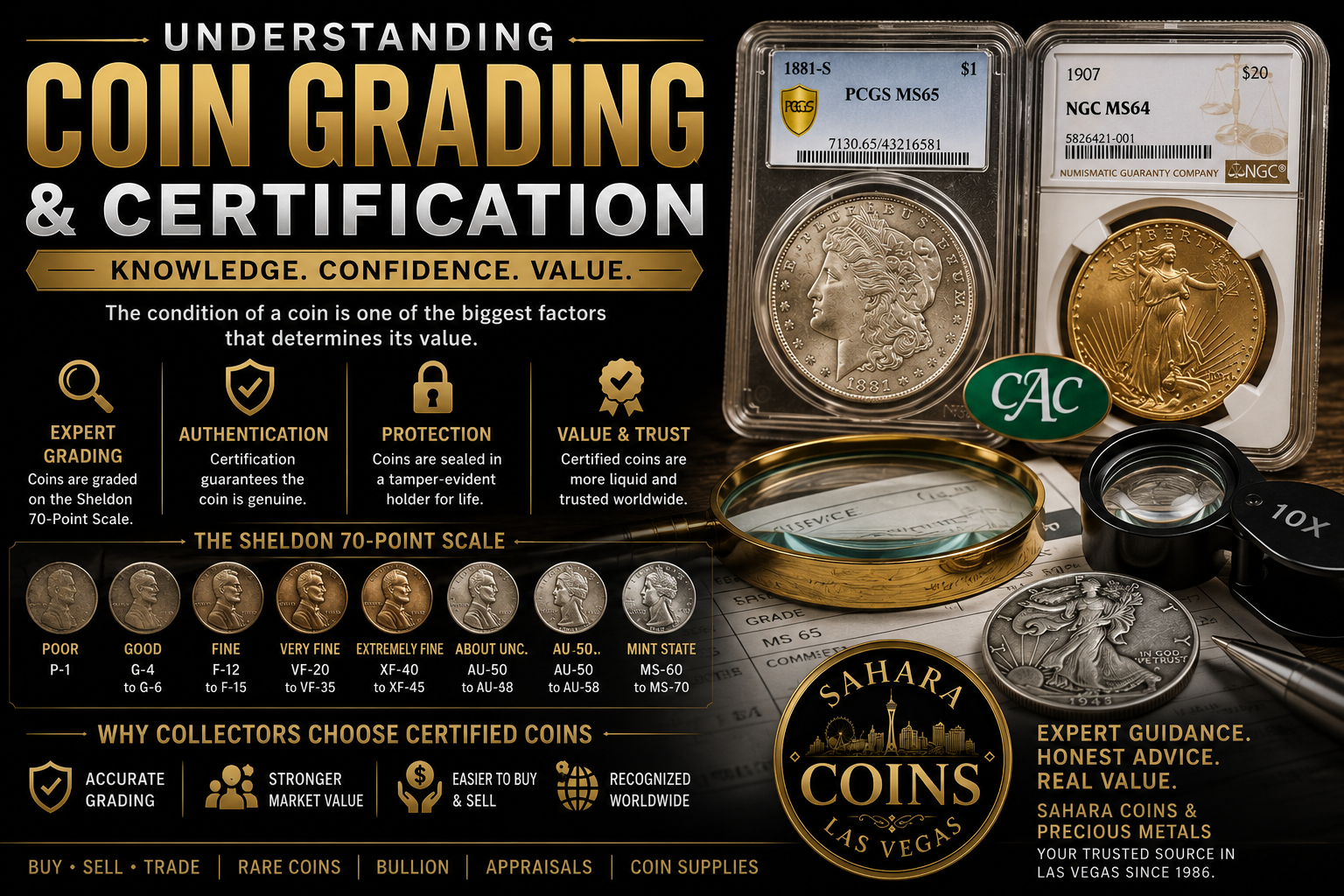
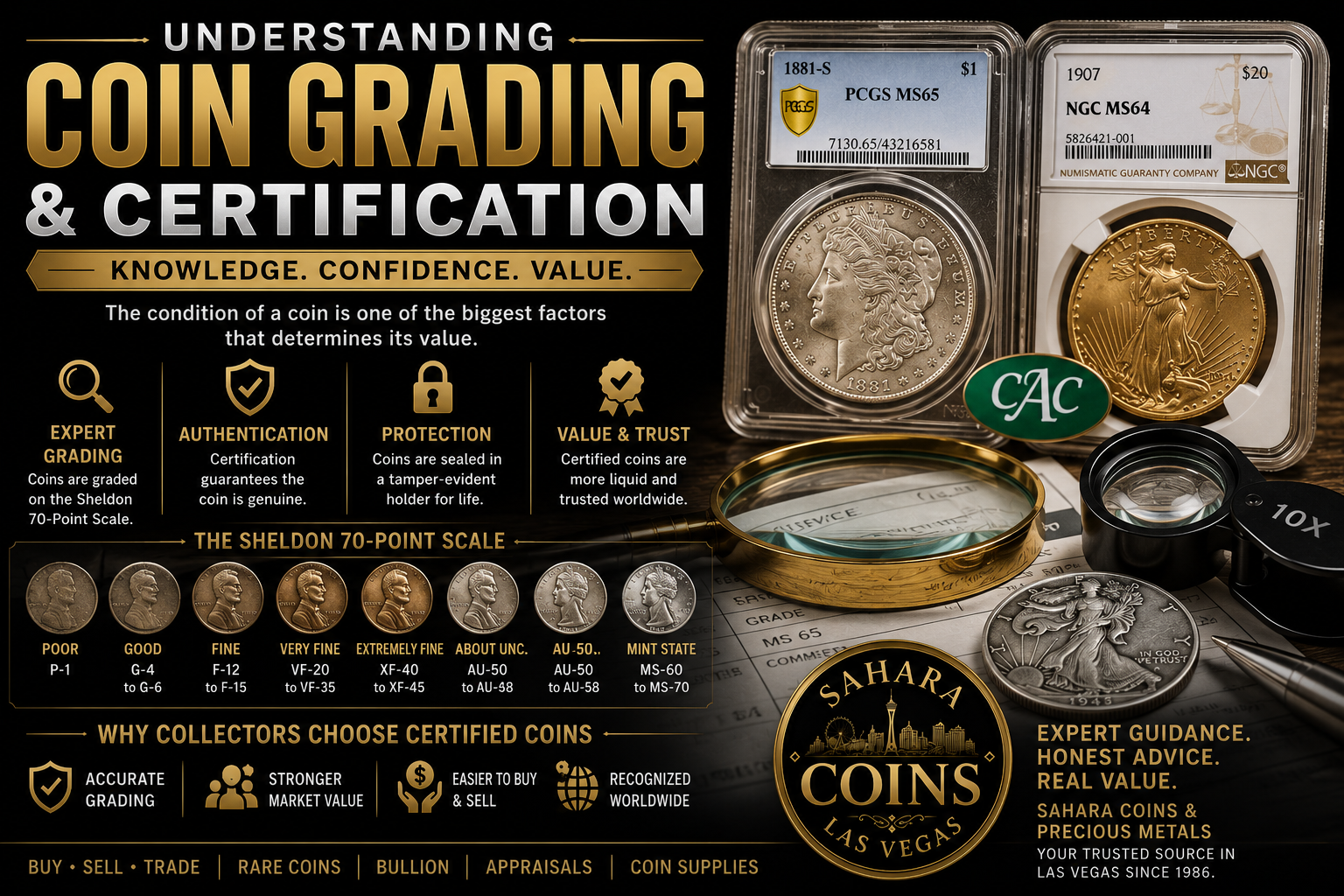
Most coins today are graded using the Sheldon Scale, a standardized 70-point grading system developed by Dr. William Sheldon in the 1940s.
The scale ranges from:
Poor (P-1)
The coin is heavily worn and barely identifiable.
Good (G-4 to G-6)
Major details are worn, but the design remains recognizable.
Fine (F-12 to F-15)
Moderate wear with many design elements still visible.
Very Fine (VF-20 to VF-35)
Moderate circulation with strong detail remaining.
Extremely Fine (XF-40 to XF-45)
Only light wear on the highest points.
About Uncirculated (AU-50 to AU-58)
Very slight wear with nearly full mint luster.
Mint State (MS-60 to MS-70)
No wear from circulation.
The differences between Mint State grades often come down to:
Contact marks
Luster
Strike quality
Eye appeal
An MS-65 coin is significantly nicer than an MS-63, while an MS-70 represents a virtually perfect coin.
What Is Coin Certification?
Coin certification is the process of having a coin authenticated, graded, and encapsulated by an independent third-party grading company.
After grading, the coin is sealed inside a tamper-evident holder—often called a "slab"—that displays:
The coin's grade
Date and mintmark
Certification number
Attribution or variety (when applicable)
Certification provides buyers and sellers with greater confidence because the coin has been evaluated by professional experts.
The Leading Grading Companies
While several grading services exist, two companies are widely recognized as the industry's most respected.
PCGS (Professional Coin Grading Service)
Founded in 1986, PCGS is known for its strict grading standards and strong reputation among collectors and investors.
Many of the world's most valuable coins have been certified by PCGS.
NGC (Numismatic Guaranty Company)
Founded in 1987, NGC is another highly respected grading service that certifies millions of coins from around the world.
NGC-certified coins are widely accepted by dealers, collectors, and auction houses.
What Is CAC?
You may also encounter coins bearing a green or gold sticker from Certified Acceptance Corporation (CAC).
CAC does not grade coins.
Instead, it reviews already certified PCGS and NGC coins and identifies examples that meet or exceed expectations for their assigned grade.
Many collectors are willing to pay a premium for CAC-approved coins because of the additional confidence they provide.
Can Two Coins Have the Same Grade but Different Value?
Yes.
Grade is only one factor affecting a coin's value.
Other factors include:
Date
Mintmark
Rarity
Historical significance
Collector demand
Eye appeal
Population reports
Two MS-65 Morgan Dollars from different years may differ in value by thousands of dollars.
Should Every Coin Be Certified?
Not necessarily.
Certification costs money, so it generally makes sense for coins that have enough value to justify the expense.
Examples often worth certifying include:
Rare dates
Key-date coins
Gold coins
High-grade silver dollars
Valuable error coins
Coins intended for resale or long-term investment
Many common circulated coins can be safely enjoyed in albums or protective holders without certification.
Common Beginner Mistakes
Many new collectors unknowingly reduce the value of their coins by making avoidable mistakes.
Some of the most common include:
Cleaning Coins
Cleaning can permanently damage a coin's original surfaces and significantly reduce its value.
If you're unsure, it's usually best to leave a coin exactly as you found it.
Assuming Every Old Coin Is Rare
Age alone does not determine value.
Many coins over 100 years old remain relatively common, while certain modern coins can be surprisingly scarce.
Buying Raw Coins Without Experience
"Raw" simply means uncertified.
Many beautiful raw coins are genuine, but beginners should exercise caution when purchasing expensive coins without professional certification.
Ignoring Eye Appeal
Two coins with the same numerical grade may look very different.
Collectors often pay premiums for attractive toning, exceptional luster, or particularly clean surfaces.
How to Protect Your Collection
Proper storage helps preserve your coins for future generations.
Some best practices include:
Handle coins only by their edges.
Store coins in quality holders or albums.
Avoid PVC-containing plastic flips.
Keep coins in a cool, dry environment.
Never polish or clean collectible coins.
Preserving original surfaces is one of the best ways to maintain a coin's value.
Learn from Trusted Experts
Coin grading takes years of experience to master.
Even experienced collectors occasionally disagree on grades, especially when evaluating high-value coins.
If you're unsure about a coin's authenticity, condition, or value, consulting with knowledgeable professionals can help you avoid costly mistakes.
Trust Sahara Coins for Expert Coin Grading Guidance
At Sahara Coins & Precious Metals, we work with collectors of every experience level—from first-time hobbyists to advanced numismatists building investment-quality collections.
Whether you're buying certified coins, evaluating an inherited collection, or wondering whether a coin should be submitted for grading, our knowledgeable team is here to help.
Visit our Las Vegas showroom to explore a wide selection of certified PCGS and NGC coins, investment-grade rarities, and collectible U.S. and world coins. We're committed to helping collectors make informed decisions with honest advice and professional expertise.
Frequently Asked Questions
Is a graded coin always worth more than a raw coin?
Not always, but certification often increases buyer confidence and can make valuable coins easier to sell.
Which is better, PCGS or NGC?
Both are highly respected third-party grading services with strong reputations throughout the coin industry.
What does MS-70 mean?
MS-70 is the highest possible Mint State grade, indicating a coin with virtually perfect surfaces as evaluated under professional grading standards.
Should I clean my coins before having them graded?
No. Cleaning can permanently reduce a coin's value and may prevent it from receiving a straight grade.
What does CAC mean on a coin holder?
A CAC sticker indicates that an already certified coin meets or exceeds expectations for its assigned grade, providing an additional level of confidence for collectors.