How Gold prices are determined
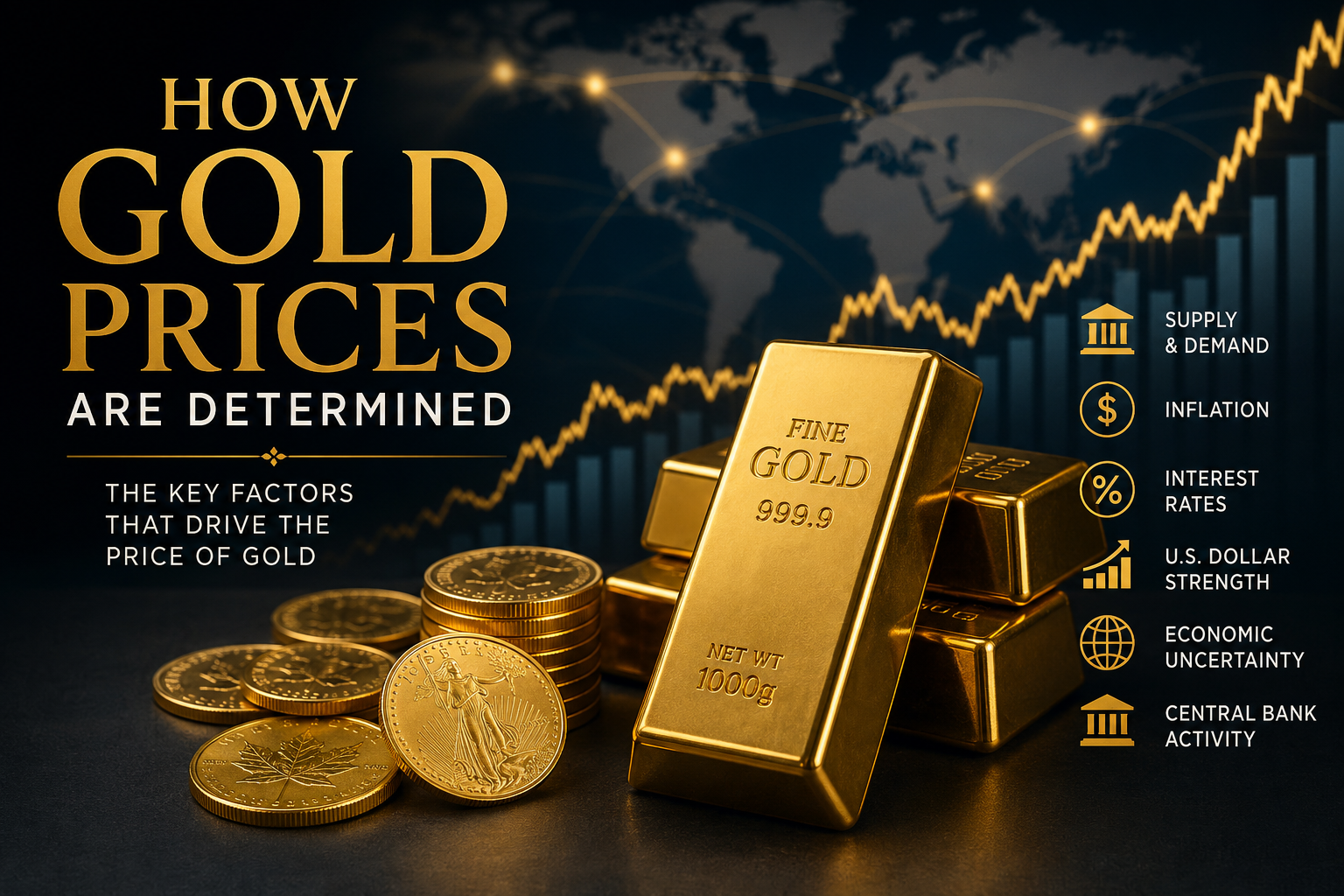
Gold prices are constantly changing, sometimes moving several times within a single minute. Unlike a product with a fixed retail price, gold is traded globally, and its value is determined by the interaction of buyers and sellers across international financial markets.
Understanding how gold prices are determined can help investors, collectors, and everyday consumers better understand why the market rises and falls.
What Is the Gold Spot Price?
The price most people see quoted for gold is known as the spot price.
The gold spot price represents the current market value of one troy ounce of pure gold for immediate settlement. A troy ounce weighs approximately 31.1 grams and is the standard unit used to measure precious metals.
The spot price acts as the global benchmark for the gold market. It changes continuously as gold is traded throughout the day in financial markets around the world.
Gold Prices Are Determined by Global Trading
There is no single person, company, or government that independently decides what gold is worth.
Instead, the price is established through a process known as price discovery. Price discovery occurs as buyers and sellers place orders based on what they believe gold is worth at that moment.
When buyers are willing to pay more for gold, the market price generally rises. When selling pressure increases and buyers are only willing to purchase at lower prices, the market price may fall.
Gold trades across several major markets, including London, New York, Shanghai, and other international financial centers. Because these markets operate in different time zones, gold is traded nearly 24 hours a day during the business week.
The Role of the London Gold Market
London is one of the most important centers of the global gold trade.
A large portion of the world's wholesale gold trading takes place through the London over-the-counter market. In an over-the-counter market, major financial institutions, bullion banks, refiners, mining companies, and other participants trade directly with one another.
London is also associated with the LBMA Gold Price, a widely recognized benchmark used by financial institutions, mining companies, central banks, and other large market participants.
The LBMA benchmark does not control the gold market by itself. Instead, it provides an important reference price based on trading activity and market demand.
The Role of Gold Futures Markets
Gold futures markets also play a major role in determining the price of gold.
A futures contract is an agreement to buy or sell a specific amount of gold at a predetermined price on a future date. These contracts are actively traded by investors, financial institutions, mining companies, manufacturers, and professional traders.
One of the most influential gold futures markets is COMEX, which is part of the CME Group in the United States.
Because gold futures are traded in high volumes, changes in futures prices can quickly influence the spot price quoted throughout the precious metals industry.
Supply and Demand
The most basic force behind gold pricing is supply and demand.
When demand for gold increases faster than available supply, prices may rise. When demand weakens or more gold becomes available for sale, prices may decline.
Gold demand comes from several major sources, including:
Investors purchasing gold as a financial asset
Central banks adding gold to their reserves
Jewelry manufacturers
Technology and industrial applications
Financial institutions and professional traders
Gold supply primarily comes from:
Mining production
Recycled gold
Sales from existing private or institutional holdings
Central bank sales
Gold mining production cannot usually increase quickly. Discovering, permitting, and developing a new gold mine can take many years. This limited ability to rapidly expand supply can make the gold market especially sensitive to changes in demand.
The Strength of the U.S. Dollar
Gold is generally quoted internationally in U.S. dollars. Because of this, changes in the value of the dollar can affect the gold price.
When the U.S. dollar strengthens, gold becomes more expensive for buyers using other currencies. This can reduce international demand and place downward pressure on the dollar-denominated gold price.
When the dollar weakens, gold becomes less expensive for buyers using other currencies. This can increase demand and support higher gold prices.
This relationship is not absolute, and gold and the dollar can occasionally rise or fall together. However, the strength of the U.S. dollar remains one of the most closely watched influences on gold.
Interest Rates and Monetary Policy
Interest rates can significantly influence investor demand for gold.
Gold does not pay interest or produce income. When interest rates are high, interest-bearing assets such as bonds and savings products may become more attractive to investors.
When interest rates are low, the opportunity cost of holding gold may decrease, making gold more appealing.
Investors also pay close attention to inflation-adjusted interest rates, often called real interest rates. These rates compare the return on interest-bearing investments with the rate of inflation.
Central bank policies, particularly decisions made by the Federal Reserve, can therefore have a major influence on gold prices.
Inflation Expectations
Gold is often viewed as a potential store of value during periods of inflation.
When investors believe that the purchasing power of paper currencies may decline, demand for gold can increase. This is because gold has a limited supply and cannot be created in the same way that governments and central banks can increase the supply of currency.
Gold prices are not determined only by current inflation. Expectations about future inflation can also move the market.
Economic reports, government spending, wage growth, energy prices, and central bank policies can all affect how investors view future inflation.
Economic and Financial Uncertainty
Gold is commonly described as a safe-haven asset because investors often turn to it during periods of uncertainty.
Demand for gold may increase during:
Recessions
Banking crises
Stock market declines
Currency instability
Sovereign debt concerns
Major political or geopolitical events
During uncertain periods, investors may seek assets that are not directly tied to the performance of a particular company, government, or currency.
However, gold does not automatically rise during every crisis. Short-term market behavior can be influenced by investors selling assets to raise cash, changes in currency values, or rapidly shifting expectations.
Central Bank Activity
Central banks hold gold as part of their official reserves.
When central banks purchase large amounts of gold, they add significant demand to the market. When they reduce their holdings, they can increase supply.
Central banks may buy gold to diversify their reserves, reduce reliance on foreign currencies, or strengthen confidence in their national financial systems.
Because central banks are among the largest participants in the gold market, their buying and selling activity can influence long-term price trends.
Investment Demand
Investment demand can cause gold prices to move quickly.
Investors gain exposure to gold through several methods, including:
Physical gold
Exchange-traded funds
Futures contracts
Options
Mining stocks
Institutional investment products
When large amounts of investment capital move into the gold market, prices may rise. When investors reduce their exposure, prices may fall.
Gold-backed exchange-traded funds can be especially influential because they allow large numbers of investors to gain exposure to gold without directly holding physical metal.
Mining Production and Recycling
Newly mined gold contributes to the available global supply, but annual mine production represents only a portion of all the gold that exists above ground.
Gold is durable and can be melted, refined, and reused. As a result, recycled gold is also an important source of supply.
When gold prices rise, more individuals and businesses may decide to sell old jewelry, coins, scrap, or other gold items. This can increase the amount of recycled gold entering the market.
Mining costs also matter. Labor, fuel, equipment, environmental compliance, and ore quality can all affect the cost of producing gold. If production becomes more expensive or mining output declines, available supply may tighten.
Geopolitical Events
Wars, trade disputes, elections, political instability, and international conflicts can affect gold prices.
These events may create concerns about economic growth, government debt, currencies, energy supplies, or global financial stability.
Gold can rise when geopolitical risk increases, particularly when investors believe the event could have lasting economic consequences.
The size and duration of the price movement usually depend on how serious the event is and how financial markets respond.
Market Sentiment and Speculation
Gold prices are influenced not only by current economic conditions but also by what investors expect to happen next.
Professional traders constantly analyze economic reports, central bank statements, inflation data, employment figures, currency movements, and geopolitical developments.
If traders expect interest rates to fall, inflation to rise, or economic conditions to weaken, they may begin purchasing gold before those changes actually occur.
This means gold prices often react to expectations rather than confirmed events.
Why Gold Prices Move So Quickly
Gold trades across a highly active global marketplace involving millions of transactions.
Prices can change rapidly in response to:
Economic reports
Central bank announcements
Currency movements
Large institutional trades
Political developments
Changes in investor sentiment
Unexpected global events
Because electronic trading allows orders to be placed almost instantly, new information can be reflected in the gold price within seconds.
The Gold Price Is a Global Consensus
Ultimately, the price of gold represents a constantly changing global consensus.
It reflects what buyers are willing to pay and what sellers are willing to accept based on current supply, demand, economic conditions, currency values, interest rates, risk, and expectations about the future.
No single factor determines the price by itself. Gold prices are the result of many interconnected forces operating across markets around the world.
By understanding these forces, investors and consumers can better interpret gold market movements and make more informed decisions about precious metals.
Learn More About Gold at Sahara Coins & Precious Metals
At Sahara Coins & Precious Metals in Las Vegas, we believe informed customers make better decisions.
Our Knowledge Center is designed to help you understand gold, silver, coins, bullion, currency, jewelry, and other valuable collectibles.
Whether you are learning about precious metals for the first time or have years of experience, our team is available to answer questions and help you better understand the gold market.