Common Misconceptions About Jewelry Value: What Your Jewelry Is Really Worth
Many people assume they know what their jewelry is worth—but the reality is that some of the most common beliefs about jewelry value are simply not true. Whether you inherited a gold necklace, own a diamond engagement ring, or have a drawer full of broken jewelry, understanding how jewelry is actually valued can help you make smarter decisions when it's time to sell.
At Sahara Coins & Precious Metals in Las Vegas, we evaluate jewelry every day and often hear the same misconceptions from customers. In this guide, we'll separate fact from fiction so you know exactly what affects the value of your jewelry.
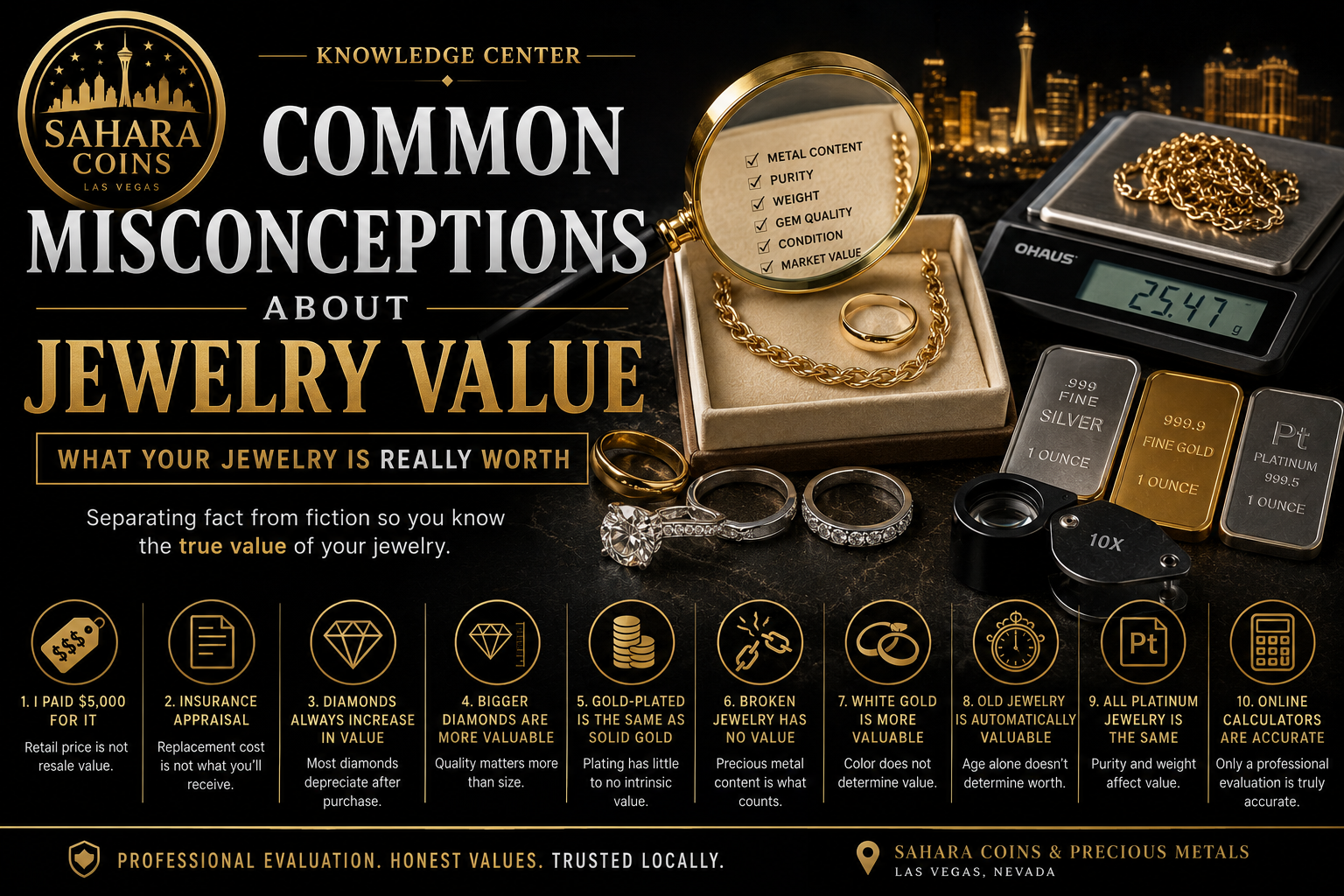
Misconception #1: "I Paid $5,000 for It, So It's Worth $5,000"
One of the biggest misconceptions is that the purchase price determines the resale value.
When jewelry is purchased from a retail jewelry store, the price typically includes:
Retail markup
Brand name
Store overhead
Marketing costs
Designer premiums
Labor and craftsmanship
Unfortunately, these costs do not usually transfer to the resale market.
When selling jewelry, buyers primarily evaluate:
Precious metal content
Gemstone quality
Current market prices
Overall condition
Brand recognition (if applicable)
The amount originally paid is rarely a factor in determining today's value.
Misconception #2: "An Insurance Appraisal Is What I'll Receive"
Insurance appraisals often create unrealistic expectations.
An insurance appraisal is designed to estimate the cost of replacing an item at retail—not its resale value.
Insurance replacement values typically include:
Current retail pricing
Potential future price increases
Replacement sourcing costs
As a result, insurance appraisals are often significantly higher than what the item would sell for on today's secondary market.
A jewelry buyer determines value based on current market conditions—not insurance replacement costs.
Misconception #3: "Diamonds Always Increase in Value"
Many people believe diamonds appreciate like gold.
While certain rare diamonds can increase in value, the majority of commercial diamonds depreciate once purchased.
Diamond value depends on:
Carat weight
Cut quality
Color
Clarity
Market demand
Certification
Shape
Natural fancy colored diamonds and exceptionally rare stones are the exception—not the rule.
Misconception #4: "The Bigger the Diamond, the More Valuable It Is"
Size is only one part of a diamond's value.
A smaller diamond with exceptional cut, color, and clarity can often be worth considerably more than a larger stone with visible inclusions or poor proportions.
Professional buyers evaluate all of the "Four Cs":
Carat
Cut
Color
Clarity
No single characteristic determines value on its own.
Misconception #5: "Gold-Plated Jewelry Is Worth the Same as Solid Gold"
Gold plating is simply a thin layer of gold applied over a base metal.
Although it may look like solid gold, gold-plated jewelry generally has very little intrinsic precious metal value.
Solid gold jewelry, on the other hand, contains measurable amounts of precious metal that can be refined and recycled.
Always look for hallmarks such as:
10K
14K
18K
22K
24K
585
750
916
These markings indicate genuine gold content.
Misconception #6: "Broken Jewelry Has No Value"
This couldn't be further from the truth.
Broken:
Necklaces
Bracelets
Rings
Earrings
Chains
can still be valuable if they contain precious metals.
Gold buyers purchase jewelry based on:
Weight
Purity
Current precious metal prices
Whether the jewelry is wearable often makes little difference when it is being purchased for its metal content.
Misconception #7: "White Gold Is More Valuable Than Yellow Gold"
Color does not determine value.
White gold, yellow gold, and rose gold all derive their value from:
Karat purity
Weight
Current gold spot price
A 14K white gold ring and a 14K yellow gold ring with identical weights generally contain the same amount of gold.
Misconception #8: "Old Jewelry Is Automatically Valuable"
Age alone doesn't make jewelry valuable.
While antique and vintage jewelry can command premium prices, value depends on factors such as:
Maker
Historical significance
Craftsmanship
Materials
Rarity
Demand
Some antique jewelry is worth thousands, while other older pieces may only have melt value.
Professional evaluation is the only way to know.
Misconception #9: "All Platinum Jewelry Is the Same"
Platinum jewelry comes in different purities.
Common stamps include:
PT950
PT900
PT850
The purity, weight, and current platinum market all influence value.
Heavier platinum pieces are often substantially more valuable than lighter items.
Misconception #10: "Online Price Calculators Tell Me Exactly What My Jewelry Is Worth"
Online calculators can provide rough estimates for precious metal content, but they cannot evaluate:
Gemstone quality
Designer brands
Antique value
Wear and condition
Repair history
Market demand
Collectibility
A hands-on evaluation by experienced professionals provides a much more accurate assessment.
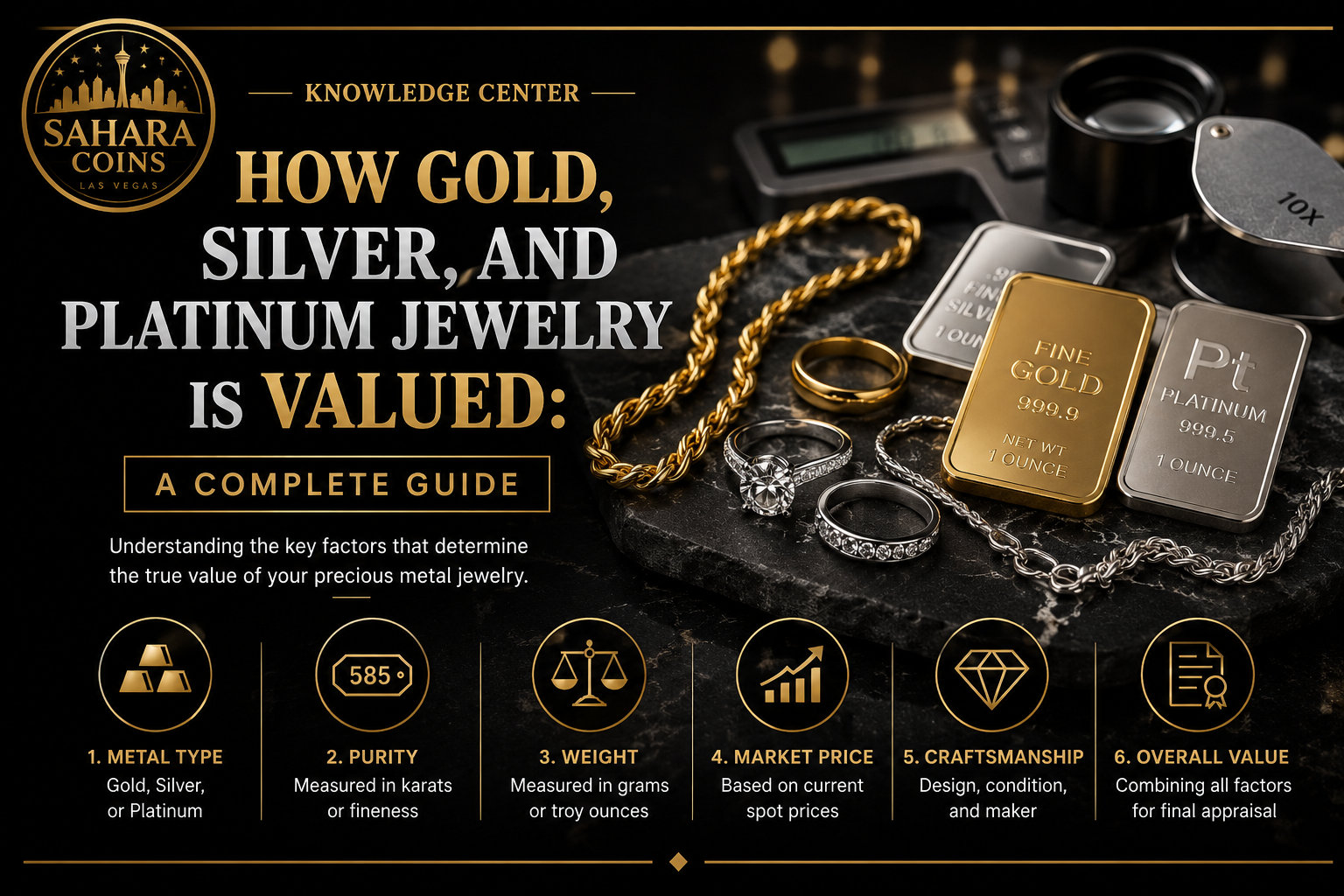
How Professionals Determine Jewelry Value
At Sahara Coins & Precious Metals, every piece is carefully evaluated using professional testing equipment and years of industry experience.
Our evaluation process considers:
Metal purity
Weight
Current gold, silver, and platinum prices
Diamond quality
Gemstone identification
Brand and designer value
Antique or estate significance
Overall market demand
This comprehensive approach ensures customers receive an accurate and transparent evaluation.
Should You Get Your Jewelry Evaluated?
If you've inherited jewelry, cleaned out an estate, found old pieces in a jewelry box, or are simply curious about what you own, a professional evaluation can provide valuable insight.
Many customers are surprised to discover that broken jewelry, outdated styles, or pieces they haven't worn in years are worth far more than expected.
Visit Sahara Coins & Precious Metals for a Professional Jewelry Evaluation
If you're looking to sell gold jewelry in Las Vegas, sell platinum jewelry, sell silver jewelry, or simply want to know what your items are worth, Sahara Coins & Precious Metals offers honest, professional evaluations with no pressure to sell.
Our experienced team uses advanced testing methods to determine the true value of your jewelry based on current precious metal markets and gemstone quality—not myths or guesswork.
Whether you have a single ring or an entire estate collection, we're here to help you understand exactly what your jewelry is worth.
Stop by Sahara Coins & Precious Metals today and discover the true value of your jewelry with a trusted local expert.