How Do Federal Reserve Interest Rate Decisions Affect Gold and Silver Prices?
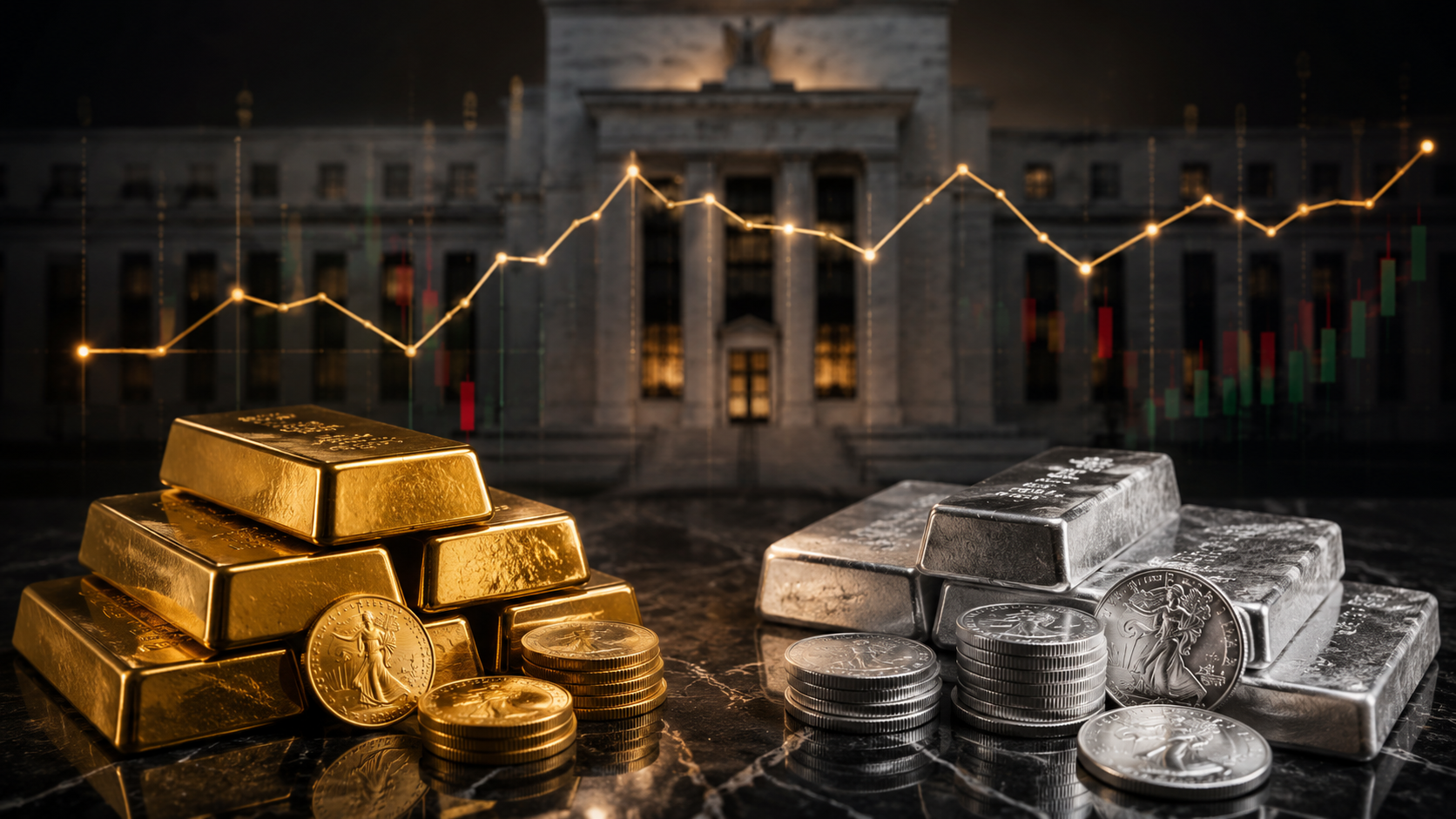
When the Federal Reserve changes its target interest rate, the effects can extend well beyond borrowing costs. Investors often watch Federal Reserve meetings closely because rate decisions can influence the U.S. dollar, Treasury yields, inflation expectations, and demand for precious metals.
So, how do interest rates affect gold and silver prices? In general, higher interest rates can create headwinds for precious metals, while lower rates can be supportive. However, gold and silver do not move according to a single rule. The market’s reaction depends on what investors expected, why the Fed changed rates, and how real yields and the dollar respond.
Why Interest Rates Matter for Gold and Silver
Physical gold and silver do not pay interest or dividends. By comparison, cash accounts, Treasury bills, and some bonds may provide income. When interest rates rise, the potential income available from those alternatives may increase. This can raise the opportunity cost of holding non-yielding assets such as gold and silver.
When rates fall, the income advantage of interest-bearing assets may narrow. That can make precious metals relatively more attractive to some investors, especially when they are seeking diversification, liquidity, or a hedge against economic uncertainty.
This relationship is a tendency, not a guarantee. Gold and silver prices can rise during periods of higher rates or decline during periods of lower rates when other market forces are stronger. For physical-metal buyers, it is also important to remember that a change in the spot market does not necessarily translate one-for-one to the final price of a specific coin or bar.
The Importance of Real Interest Rates
Many precious-metals market participants focus less on stated, or nominal, interest rates and more on real interest rates. A real rate is broadly understood as an interest rate adjusted for inflation expectations.
For example, if nominal yields are rising but inflation expectations are rising at a similar or faster pace, real yields may remain low or fall. In that environment, gold may still attract interest. Conversely, if yields rise while inflation expectations are stable or declining, real yields may increase, which can be a challenge for gold and silver demand.
Real yields are only one input, but they help explain why a Fed rate hike does not automatically cause precious metals to fall. Markets also consider whether changing yields reflect confidence in economic growth, concern about inflation, or a shift toward safer assets.
How the U.S. Dollar Can Affect Precious Metals
Gold and silver are commonly priced in U.S. dollars on global markets. Because of this, movements in the dollar can matter. A stronger dollar may make dollar-priced metals more expensive for buyers using other currencies, which can weigh on demand. A weaker dollar can have the opposite effect.
Federal Reserve policy can influence currency markets because changing U.S. rates may alter how global investors view dollar-denominated assets. Still, exchange rates respond to many factors, including economic conditions overseas, central-bank policy in other countries, and geopolitical developments. A Fed decision can therefore coincide with a move in the dollar without being the sole reason for it.
What Often Happens When the Fed Raises Rates?
A rate increase is often viewed as potentially negative for gold and silver because it may increase yields on competing assets and support the U.S. dollar. But the actual reaction can vary widely.
- If the rate hike was widely expected: prices may react little because markets may have already accounted for the decision.
- If the Fed sounds more aggressive than expected: yields and the dollar may rise, which can pressure metals.
- If the Fed raises rates because inflation remains a concern: some investors may continue to see precious metals as relevant despite higher rates.
- If investors worry that tighter policy could slow the economy: demand for perceived safe-haven assets can sometimes increase.
In other words, markets frequently respond to the difference between expectations and the Fed’s message—not solely to the rate decision itself. The policy statement, the Fed chair’s remarks, and guidance about the possible path of future rates may all matter to traders and investors.
What Often Happens When the Fed Cuts Rates?
Rate cuts are often considered supportive for gold and silver because they can reduce the opportunity cost of holding non-yielding metals and may put downward pressure on the dollar. Yet a cut can occur for very different reasons.
If the Fed is cutting rates because inflation is easing and economic conditions appear stable, the response in precious metals may be modest. If cuts are connected to economic stress, recession concerns, or financial-market uncertainty, demand for gold may be influenced by safe-haven interest as well as lower yields.
As with rate increases, context matters. A rate cut that markets expected may produce a limited immediate move, while an unexpected decision or a substantial change in the Fed’s outlook can prompt a more pronounced reaction across metals, bonds, currencies, and equities.
Gold and Silver Do Not Always React the Same Way
Gold and silver share several monetary and investment-related drivers, but they have important differences. Gold is often watched as a monetary metal and a store-of-value asset. Silver has those characteristics too, but it also has significant industrial uses.
As a result, silver may be more sensitive than gold to changes in manufacturing activity, technology demand, and the broader economic outlook. During periods when rate decisions shape expectations for growth, silver can be especially volatile. A lower-rate environment may support investment demand, but concerns about weaker industrial activity can pull silver in another direction.
For this reason, a Fed announcement may affect gold and silver in the same broad direction, at different magnitudes, or occasionally in different directions. Looking at the wider market backdrop can be more useful than assuming the two metals will always behave alike.
Other Factors That Can Move Gold and Silver Prices
Federal Reserve decisions are important, but they are not the only drivers of precious-metals prices. Buyers and sellers should consider the broader picture, including:
- Inflation data and inflation expectations
- U.S. Treasury yields and real yields
- Strength or weakness in the U.S. dollar
- Economic growth and recession expectations
- Geopolitical events and financial-market uncertainty
- Central-bank activity and global investment demand
- Industrial demand and supply conditions, particularly for silver
- Physical product availability and dealer premiums
The spot price is only one part of a physical precious-metals purchase. The specific product, its premium, availability, and condition can also affect the final transaction price. Buyers comparing physical products should evaluate the total price, product type, and their own objectives rather than focusing only on an intraday spot-price move.
How to Follow a Federal Reserve Meeting
For a clearer view of how a Fed decision may affect gold and silver, look beyond the headline rate change. Consider the policy statement, the Fed chair’s press conference, updated economic projections when available, and the market’s reaction in Treasury yields and the U.S. dollar.
It can also be helpful to ask: Was the decision expected? Is the Fed more concerned about inflation or economic weakness? Are investors revising their outlook for future rates? These questions provide more context than a simple “rate hike” or “rate cut” label.
Readers seeking primary-source context can review the Federal Reserve’s Federal Open Market Committee meeting calendars, statements, and related materials. Those materials can help distinguish the announced decision from the broader policy outlook markets may be evaluating.
Key Takeaway
Interest rates can affect gold and silver prices by changing the appeal of income-producing alternatives, influencing real yields, and moving the U.S. dollar. Lower rates may be favorable for precious metals in some circumstances, while higher rates may create pressure. But the relationship is not automatic, and price movements often reflect expectations, inflation, growth concerns, and market sentiment all at once.
For Las Vegas buyers considering physical bullion, a long-term plan and an understanding of the products being purchased can be more useful than trying to predict the outcome of a single Federal Reserve meeting.
Talk With a Las Vegas Precious Metals Professional
Whether you are new to bullion or comparing physical gold and silver options for your collection or portfolio, Sahara Coins & Precious Metals can help you understand the differences among products. Explore options to buy gold and silver, visit our Las Vegas shop, or contact our team to discuss the products that may fit your needs. This article is for educational purposes only and is not investment, tax, or legal advice.